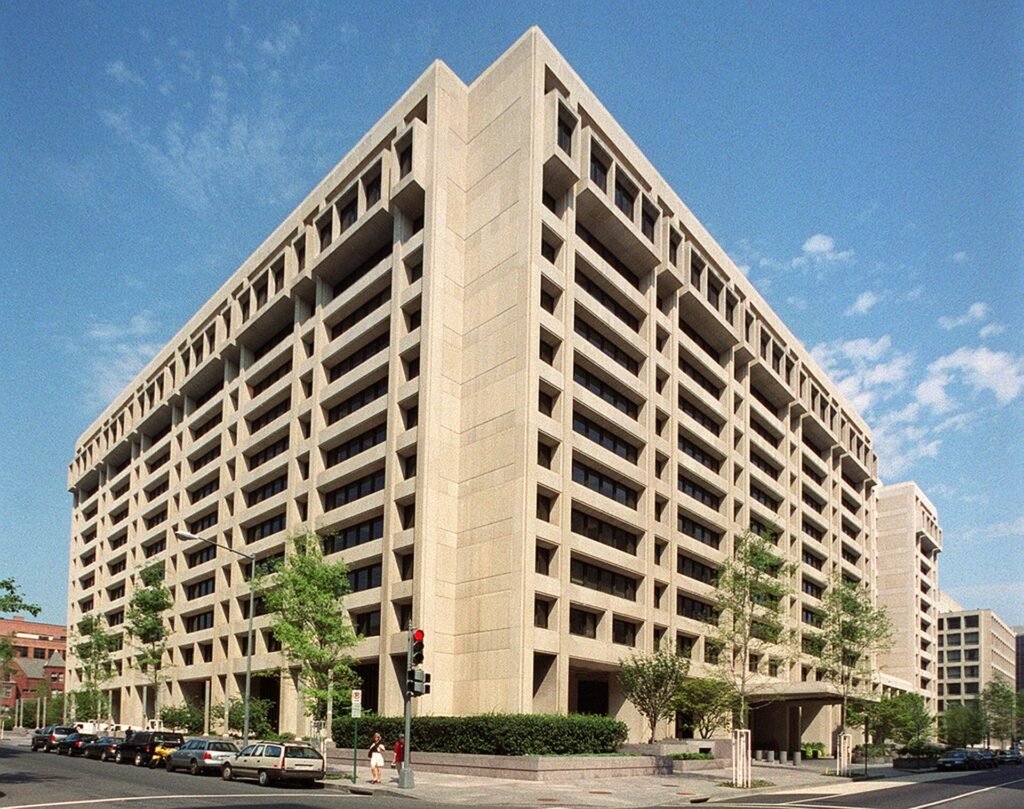
The International Monetary Fund, or IMF, is an international organization of 191 member countries that works to promote monetary cooperation, financial stability and sustainable growth. It lends to governments in economic crisis, advises them on policy and trains their officials. It also issues an international reserve asset called Special Drawing Rights.
History of the IMF
The IMF was conceived in July 1944 at the United Nations Bretton Woods Conference in New Hampshire, which was attended by 44 countries. The delegates wanted a framework for international economic cooperation that would avoid a repeat of the competitive currency devaluations that contributed to the Great Depression of the 1930s. The same conference created the International Bank for Reconstruction and Development, now part of the World Bank Group.
The fund describes three critical missions: furthering international monetary cooperation, encouraging the expansion of trade and economic growth, and discouraging policies that would harm prosperity. These aims have stayed fixed, while the tools have changed. During the Covid-19 pandemic, for example, the IMF temporarily raised access to its funds, extended zero interest rates on its concessional loans and permanently set the interest rate on emergency financing at zero.
Structure and membership of the IMF
The IMF is governed by and accountable to its member countries. At the top is the Board of Governors, which has one governor and one alternate from each member, usually the top official of the central bank or the finance ministry. The board meets once a year at the IMF and World Bank Annual Meetings.
Twenty-five of the governors sit on the International Monetary and Financial Committee, which advises the Executive Board. The 25-member Executive Board represents the whole membership and oversees day-to-day work, supported by IMF staff. The Managing Director heads the staff, chairs the Executive Board and is assisted by four Deputy Managing Directors.
What the IMF does
The fund has four core activities. The first is policy advice: it holds a regular dialogue with governments, assesses economic conditions and recommends policies that support growth and help prevent crises in the international monetary system. The second is financial assistance, in the form of loans and other aid to members facing crises. The third is capacity development, which means technical assistance and training. The fourth is issuing Special Drawing Rights, which supplement member countries’ official reserves.
The IMF explains that crises have domestic and external causes. Domestic causes include inappropriate fiscal and monetary policies, an exchange rate fixed at the wrong level, a weak financial system and political instability. External causes include natural disasters, large swings in commodity prices and sudden changes in market sentiment that move capital in and out of a country.
The fund notes that crises often involve several problems that interact, such as a balance of payments shortfall, a failing banking system and an unsustainable fiscal deficit. They can slow growth, raise unemployment, lower incomes and push an economy into deep recession, and in acute cases a default or restructuring of sovereign debt may be unavoidable. In low-income countries, IMF lending is typically meant to encourage financial support from other donors and development partners rather than to replace it.
Its lending aims to give a country breathing room to adjust policies in an orderly way, to signal that sound policies are being put in place and to protect the most vulnerable through policy conditions. A country starts by making a request, and talks with IMF staff then produce a staff-level agreement on the terms. That agreement is not final. Countries with strong policies may get precautionary financing with limited conditions, and urgent needs can be met through emergency instruments with limited conditionality.
Special Drawing Rights are not a currency in everyday use. Total global allocations stand at about SDR 204.2 billion, or roughly $293 billion, and members can voluntarily exchange them for currencies among themselves.
Funding and quotas
IMF funds come from three sources: member quotas, multilateral borrowing arrangements and bilateral borrowing agreements. Quotas are the primary source, and each reflects a member’s size and position in the world economy. The fund says contributions count as the contributing country’s own reserve assets, so the model needs no budget appropriations or taxpayer support.
Quotas are reviewed regularly. The 16th review concluded in December 2023 with approval of a 50 percent increase, and the next step was for members to consent to their own increases. The previous increase, to SDR 477 billion (about $640 billion), was agreed in the 14th review in December 2010 and took effect in January 2016.
Two backstops sit behind quotas. The New Arrangements to Borrow is the main multilateral backstop, with 40 participants and SDR 364 billion committed after it was doubled effective January 2021. Activating it requires support from 85 percent of participants eligible to vote, and it was activated 10 times between April 2011 and February 2016. Bilateral borrowing agreements are a third line of defense, and the 2020 round included 42 creditors.
As of mid-December 2023, the fund’s total resources were about SDR 982 billion, which gave it a lending capacity of about SDR 695 billion, or roughly $932 billion.
IMF vs. World Bank
The two institutions share their origin at Bretton Woods and their annual meetings, but their jobs differ. The IMF focuses on international monetary cooperation and economic stability, with surveillance, crisis lending and training for officials. The World Bank concentrates on development, financing projects through loans, interest-free credits and grants. A country in a balance of payments crisis is more likely to turn to the IMF, while one building schools or power lines is more likely to work with the World Bank.
More in Economics
Key facts
- The IMF has 191 member countries.1
- It was conceived in July 1944 at the Bretton Woods Conference, attended by 44 countries.1
- Its funds come from member quotas, the New Arrangements to Borrow and bilateral borrowing agreements.2
- A 25-member Executive Board oversees its day-to-day work.1
- As of mid-December 2023, its lending capacity was about SDR 695 billion, or roughly $932 billion.2
Related concepts
In the news
Quick checkWhat are Special Drawing Rights?Show answer
They are an international reserve asset issued by the IMF that supplements members' official reserves, with total allocations of about SDR 204.2 billion.
Sources
- International Monetary Fund, What is the IMF?, https://www.imf.org/en/About/Factsheets/IMF-at-a-Glance
- International Monetary Fund, Where the IMF Gets Its Money, https://www.imf.org/en/About/Factsheets/Where-the-IMF-Gets-Its-Money
- International Monetary Fund, IMF Lending, https://www.imf.org/en/About/Factsheets/IMF-Lending
- International Monetary Fund, Senior Officials and organizational structure, https://www.imf.org/en/About/senior-officials
- World Bank, History, https://www.worldbank.org/en/about/history
Editorially reviewed by Specialty Digest Editorial TeamLast reviewed November 4, 2026Researched and drafted with AI assistanceReport an issue