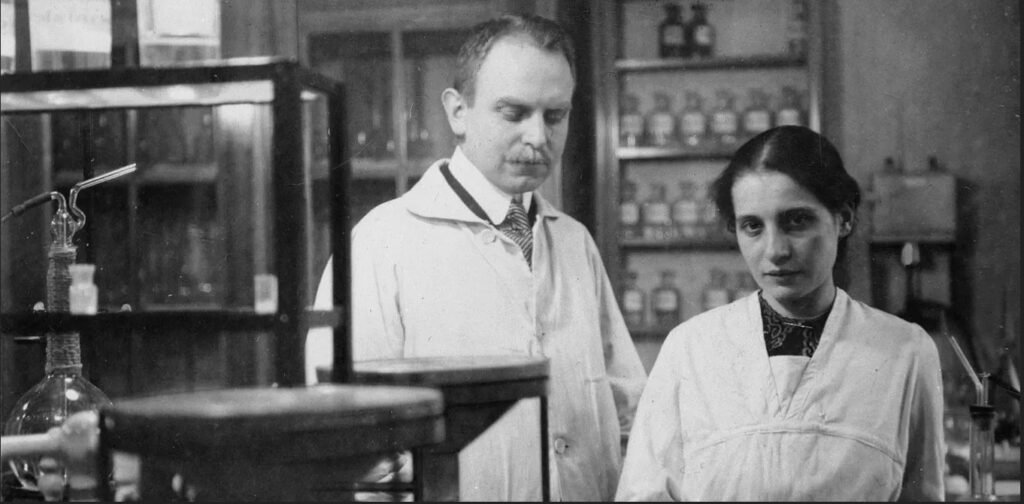
The discovery of nuclear fission was the realization, in December 1938 and January 1939, that a uranium nucleus struck by a neutron can split into two lighter nuclei and release a large amount of energy. The chemical evidence came from Otto Hahn and Fritz Strassmann in Berlin, and the physical explanation from Lise Meitner and her nephew Otto Frisch.
Background to the discovery of nuclear fission
The discovery of the neutron in 1932 gave physicists an ideal probe of the nucleus. In 1934 Enrico Fermi bombarded uranium with neutrons and believed he had produced the first elements heavier than uranium. Most scientists assumed that a neutron striking a large nucleus could cause only small changes in its numbers of protons and neutrons.
The discovery of the neutron also launched an international race to make an element heavier than uranium in the laboratory. The competitors, according to the American Physical Society, were Rutherford in England, Irène Joliot-Curie in France, Fermi in Italy, and Meitner and Hahn in Germany.
One chemist, Ida Noddack, pointed out that Fermi had not ruled out the possibility that the uranium had broken up into lighter elements. She offered no theoretical basis for how that could happen, her paper was largely ignored, and no one followed up on it, including Noddack herself.
Meitner, Hahn and Strassmann began bombarding uranium and other elements with neutrons and identifying the decay products. The roles were clear. Hahn carried out the careful chemical analysis, while Meitner, the physicist, explained the nuclear processes. Meitner had studied physics in Vienna and worked at the Kaiser Wilhelm Institute for Chemistry in Berlin, where she eventually headed a physics section.
Because she had Jewish ancestry, Meitner was forced to flee Germany in July 1938. She left with two small suitcases and took a position at the Nobel Institute for Physics in Stockholm, where she had few resources and felt isolated. She kept up a correspondence with Hahn and went on advising him about their joint research.
The discovery
In December 1938 Hahn and Strassmann, continuing the experiments in Berlin, found what appeared to be isotopes of barium among the products of bombarding uranium with neutrons. This should have been impossible, since a tiny neutron was not thought capable of cracking a nucleus in two to produce much lighter elements. Hahn wrote to Meitner about the puzzle and added, “Perhaps you can come up with some sort of fantastic explanation.”
Meitner received the letter during the Christmas holiday, when her nephew Otto Frisch, a physicist at Niels Bohr’s institute in Copenhagen, was visiting. They trusted Hahn’s chemistry and could not explain his result. They went for a walk in the snow, Frisch on skis and Meitner on foot, and stopped at a tree stump to do calculations.
Meitner suggested thinking of the nucleus as a liquid drop, a model proposed earlier by George Gamow and promoted by Bohr. Frisch drew diagrams showing how a uranium nucleus hit by a neutron might elongate, pinch in the middle and divide in two, like a drop of water.
The two halves would be pushed apart by their mutual electric repulsion with an energy of about 200 million electron volts. Meitner then found that the two daughter nuclei together weigh about one-fifth of a proton mass less than the original uranium nucleus. Plugged into Einstein‘s formula E=mc², that missing mass works out to about 200 million electron volts. Everything fit.
How nuclear fission was confirmed and named
Frisch left Sweden after Christmas dinner, and he and Meitner finished the work by long-distance telephone. Frisch spoke briefly with Bohr, who carried the news to the United States, where it met immediate interest. Frisch also named the process. He borrowed the word fission after learning that biologists use “binary fission” for the division of a cell.
Meitner and Frisch sent their paper to the journal Nature in January 1939, and it was published on 11 February 1939. Hahn and Strassmann published their own findings separately.
Scientists soon recognized that if splitting a nucleus also released additional neutrons, those neutrons could split more nuclei and sustain a chain reaction. That possibility drew rapid attention in laboratories around the world.
Impact and legacy of the discovery
The Nobel Foundation notes that fission proved important in developing both nuclear weapons and nuclear energy. A controlled chain reaction is the basis of the nuclear reactor and of nuclear power. An uncontrolled one powered the weapons described in the entry on the atomic bombings of Hiroshima and Nagasaki.
Albert Einstein once called Meitner the “German Marie Curie,” and the fission episode is among the reasons her name is now widely known. She later recalled that the discovery “opened up a new era in human history.” She refused to work on the Manhattan Project, saying that she would have nothing to do with a bomb.
Fission was a direct consequence of earlier work on the structure of the atom, described in the entries on the discovery of the atomic nucleus and the discovery of radioactivity.
Disputes over credit
Credit for fission is one of the best-known disputes in modern science. Otto Hahn alone received the Nobel Prize in Chemistry for 1944, which was presented to him in 1945, for the discovery of the fission of heavy nuclei. The Nobel Foundation describes the work of Meitner and Frisch as having proved that the uranium nucleus had been split, but neither of them shared the prize.
The American Physical Society records that Hahn and Strassmann published their finding separately and did not acknowledge Meitner’s role. In 1997 the magazine Physics Today concluded that the omission was a rare instance in which personal negative opinions apparently led to the exclusion of a deserving scientist from a Nobel Prize.
Hahn’s own contribution, the chemical identification of barium, is not in doubt. What remains debated is how much weight the physical interpretation should have carried in the prize.
More in Physics
Key facts
- Hahn and Strassmann found barium among the products of bombarding uranium with neutrons in December 1938.1
- Meitner and Frisch explained the result as the splitting of the nucleus, with an energy release of about 200 MeV, and Frisch named the process fission.1
- Meitner and Frisch published their paper in Nature on 11 February 1939.2
- Otto Hahn alone received the Nobel Prize in Chemistry for 1944 for the discovery of the fission of heavy nuclei.3
Related concepts
Quick checkWho discovered nuclear fission?Show answer
Otto Hahn and Fritz Strassmann found the chemical evidence in Berlin in December 1938, and Lise Meitner and Otto Frisch explained it as nuclear splitting. Only Hahn received the Nobel Prize for it, which remains a well-known credit dispute.
Sources
- American Physical Society, This Month in Physics History: December 1938, Discovery of Nuclear Fission, https://www.aps.org/apsnews/2007/12/december-1938-discovery-nuclear-fission
- American Physical Society, This Month in Physics History: 1939, Meitner/Frisch paper on nuclear fission, https://www.aps.org/apsnews/2015/02/1939-meitner-frisch-nuclear-fission
- Nobel Prize Outreach, Otto Hahn: Facts (Nobel Prize in Chemistry 1944), https://www.nobelprize.org/prizes/chemistry/1944/hahn/facts/
Editorially reviewed by Specialty Digest Editorial TeamLast reviewed November 5, 2026Researched and drafted with AI assistanceReport an issue