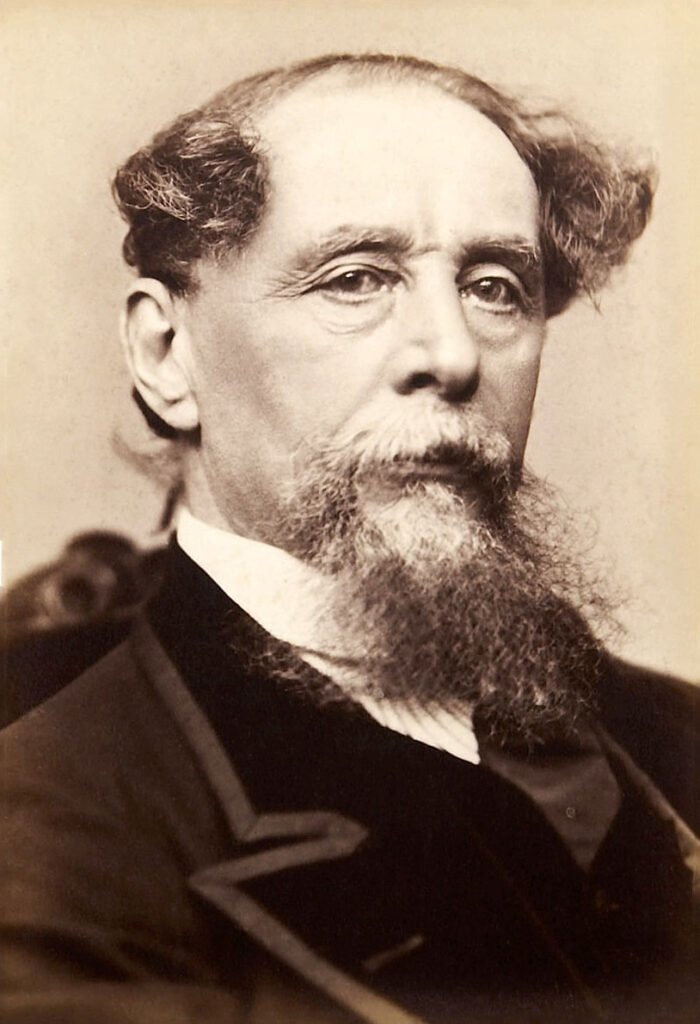
Great Expectations is a novel by the English writer Charles Dickens, first published as a weekly serial between December 1860 and August 1861. It follows Pip, an orphan from the Kent marshes who comes into a mysterious fortune and moves to London to become a gentleman. The book is a story of growing up, in which Pip learns that wealth and social rank do not decide a person’s worth.
Background and serial publication of Great Expectations
Dickens wrote Great Expectations for his own weekly magazine, All the Year Round. It ran in 36 weekly parts, covering 59 chapters, from 1 December 1860 to 3 August 1861. The serial had no illustrations.
The decision to start it was partly practical. Sales had fallen while a serial by another author, Charles Lever, ran in the magazine, so Dickens led the issue of 1 December 1860 with a new story of his own. He had finished the first four instalments, covering chapters 1 to 7, by 24 October 1860 and began advertising on 27 October. He had first thought of a longer novel in twenty monthly parts, the format he used for David Copperfield.
In the United States the story ran in Harper’s Weekly from 24 November 1860, a week before the English serial began, with illustrations by John McLenan. A three-volume edition followed in 1861. It was Dickens’s thirteenth novel and only his second narrated in the first person, after David Copperfield.
Plot summary of Great Expectations
The story opens in a churchyard on the marshes, where the young orphan Pip is frightened into helping an escaped convict. He lives with his harsh older sister and her kind husband, the blacksmith Joe Gargery.
Pip is then asked to play at Satis House, home of the wealthy and embittered Miss Havisham. There he meets her adopted daughter Estella, who is beautiful and cold, and he becomes ashamed of his humble home and of Joe.
A lawyer, Mr. Jaggers, later announces that an unknown benefactor has given Pip large expectations. Pip goes to London, takes lessons to become a gentleman, and assumes Miss Havisham is his patron.
He learns instead that the donor is the convict, Abel Magwitch, who has returned from transportation to Australia. Magwitch also turns out to be Estella’s father. Pip tries to help him escape the country, the plan fails, and Magwitch is caught. Pip, ruined and ill, is nursed by Joe, and he later reunites with Estella.
Characters in Great Expectations
Philip Pirrip, called Pip, narrates as an adult and judges his younger self. Joe Gargery is the moral center of the book, a simple and loyal man who is always generous. Miss Havisham, who was jilted on her wedding day and lives in the decaying house, uses Estella as a tool for revenge on men.
Estella has been trained to be cold and, like Pip, is shaped by forces beyond her control. Herbert Pocket becomes Pip’s close friend in London, and Jaggers is a shrewd lawyer who keeps his professional distance. Magwitch is feared at first, and he becomes a figure of loyalty and suffering.
Themes in Great Expectations
Class and gentility are the main subject. The Victorian Web introduction to the novel asks what a gentleman really is, and shows Pip trading the iron chains of the forge for golden ones in London, where social climbing brings its own kind of confinement.
Ambition and expectation drive Pip’s choices. His wish to be worthy of Estella leads him to look down on those who love him, and the novel treats such expectations as a source of both hope and exploitation.
Guilt and conscience run through the story from the first scene. Pip carries the sense of having been touched by crime, and his eventual respect for Magwitch is part of how he grows morally. The book also draws on the changing London of the early industrial age, with its contrast between the clean marsh river and the polluted city.
Style, structure and the two endings
Dickens keeps closely to a child’s point of view in the opening chapters, which makes the first scenes feel menacing, while the older narrator brings humor and self-awareness. The plot is tightly knit, with few digressions and a small cast compared with his earlier novels.
The novel has two endings. In the original, Pip and Estella do not end up together in the traditional way. The revised version, favored by the novelist Edward Bulwer-Lytton, rewrites the last scene at Satis House so that the pair seem to have learned from their mistakes.
The settings carry meaning. The novel moves between the marshes and river country of Pip’s childhood, the decaying Satis House and the crowded streets of London, and Dickens uses mud, dust, gardens and the river as recurring images of a world that can feel like a prison. Pip’s change of clothes at the end of Chapter 19 marks the moment his social class changes, while Miss Havisham embodies a fantasy of aristocratic status frozen in time.
Reception and legacy of Great Expectations
The book has long been counted among Dickens’s finest novels, and critics often read Pip as a portrait of the young Dickens himself. Some have linked Estella’s coldness to his own unrequited feelings for Maria Beadnell.
It has been adapted many times for film, television and stage, including David Lean’s 1946 film, and it is widely taught in schools and universities as a classic of the English novel. Project Gutenberg, which offers a free text of the book, describes it as a novel first published serially from 1860 to 1861.
More in Literature
Key facts
- Great Expectations ran in 36 weekly parts in All the Year Round from 1 December 1860 to 3 August 1861.1
- It has 59 chapters and was serialized without illustrations in England.1
- Harper's Weekly began the American serial on 24 November 1860 with illustrations by John McLenan.1
- It was Dickens's thirteenth novel and his second told in the first person, after David Copperfield.2
- It was issued in a three-volume edition in 1861.1
Related concepts
Quick checkWhere was Great Expectations first published?Show answer
It appeared in weekly parts in Dickens's magazine All the Year Round, from 1 December 1860 to 3 August 1861.
Sources
- The Victorian Web, The Serialisation of Charles Dickens's Great Expectations in All the Year Round, https://victorianweb.org/authors/dickens/ge/geserialisation.html
- The Victorian Web, An Introduction to Charles Dickens's Great Expectations (1861), https://victorianweb.org/authors/dickens/ge/pva10.html
- Project Gutenberg, Great Expectations by Charles Dickens (ebook record), https://www.gutenberg.org/ebooks/1400
Editorially reviewed by Specialty Digest Editorial TeamLast reviewed November 5, 2026Researched and drafted with AI assistanceReport an issue