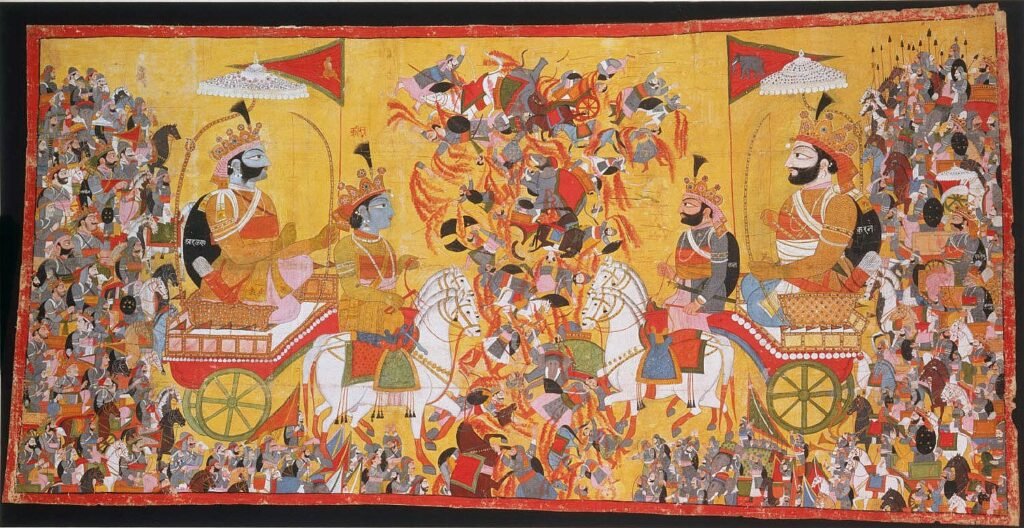
The Mahabharata is an ancient Sanskrit epic of India, traditionally credited to the sage Vyasa, that tells of the rivalry between two branches of a royal family, the Pandavas and the Kauravas, and of their war at Kurukshetra for the throne of Hastinapura. By the traditional count it has about 100,000 verses, which makes it the longest epic poem ever written, and it contains the Bhagavad Gita.
Background and composition of the Mahabharata
Tradition says Vyasa dictated the verses and the god Ganesha wrote them down. Vyasa is also a character in the story. The epic was first narrated by one of Vyasa’s students at a snake sacrifice held by the great-grandson of one of its major characters. The composition is generally thought to date to the fourth century BCE or earlier, and its events play out across the Indian subcontinent and neighboring regions.
The text is organized into eighteen parvans, or books. Within the main story are many smaller tales about people living and dead, and long philosophical discourses. The best known of these is the Bhagavad Gita, which is set on the battlefield. The size of the epic and the many versions that circulated in different regions made establishing a single text a major scholarly project.
The critical edition
The Bhandarkar Oriental Research Institute in Pune undertook that project. Work began in April 1919 and the finished Critical Edition was released on 22 September 1966 by Dr. Sarvepalli Radhakrishnan, then President of India. The editors included V. S. Sukthankar, who wrote the long Prolegomena, S. K. Belvalkar, S. K. De and R. N. Dandekar. Their work took about five decades and drew on 1,259 manuscripts.
The constituted text has eighteen parvans and more than 89,000 verses, and the edition fills 19 volumes and more than 15,000 pages. That figure is lower than the traditional round number of 100,000, because the editors tried to reconstruct the oldest recoverable text and not to include every variant. The Institute also edited the Harivamsha, a related work, between 1966 and 1969, and has published volumes of a Cultural Index to the epic. That project gathered more than 150,000 reference cards, and two volumes of the index have appeared.
Summary of the Mahabharata
The story begins with King Shantanu of Hastinapura. His son Devavrata gives up his claim to the throne and vows lifelong celibacy so that his father can marry Satyavati, and he is known afterward as Bhishma. When Shantanu’s line dies out, Satyavati’s son Vyasa fathers two sons with the widowed queens: Dhritarashtra, who is born blind, and Pandu. Because Dhritarashtra is barred from kingship, Pandu is crowned.
Pandu’s five sons, the Pandavas, are born through the gods to his wives Kunti and Madri, while Dhritarashtra and his wife Gandhari have one hundred sons, the Kauravas, and a daughter. After Pandu’s death all of the princes are raised in Hastinapura and taught by Kripa and Drona. Hostility develops between the two branches, especially between the Kaurava Duryodhana and the Pandava Bhima. The archer Karna, a rival of Arjuna, joins Duryodhana’s side. Duryodhana plots to kill his cousins, who escape a burning palace and live in hiding.
The Pandavas then win Draupadi as their common wife after Arjuna succeeds in an archery contest, and they build a new kingdom at Indraprastha. A rigged dice game costs Yudhishthira, the eldest Pandava, his kingdom, and the brothers go into exile for thirteen years. When they return and their share is refused, both sides prepare for war. At Kurukshetra the armies fight for eighteen days, and Krishna serves as Arjuna’s charioteer and gives the teaching recorded in the Bhagavad Gita. The Pandavas win, but at enormous cost.
Themes and interpretation of the Mahabharata
The main theme is dharma, a concept of duty, law and right conduct, tested in situations where duties conflict. Characters must choose between loyalty to family, obligations to a ruler and justice. In contrast with the Ramayana, the epic presents its characters with their full human failings, and few of them are wholly good or wholly bad.
A second theme is the cost of war and of the quarrels over inheritance that lead to it. The conflict begins as a dispute within one family over who may rule, and it ends with enormous loss on both sides.
The epic also functions as an encyclopedia. Its philosophical discourses on duty, action and the nature of the self sit beside genealogies, tales of sages and practical teaching on kingship. That mixture is why scholars read it as literature, history, theology and law at once.
Reception and legacy of the Mahabharata
The Mahabharata is regarded as one of the most important works of ancient Indian literature and, indeed, of world literature. Through retellings, regional versions, drama, dance, painting, film and television it has shaped storytelling across South Asia. The Ramayana is its companion epic, and the two together form a base for much of the narrative culture of India and the wider region.
For believers, the epic and especially the Gita are part of the religious heritage of Hinduism. For scholars, the size of the manuscript tradition makes the Critical Edition a landmark of textual criticism. The Institute’s project has also produced reference tools, including an index of verse quarters and a bibliography of more than six thousand entries on the epic.
The epic’s reputation rests on both scale and substance. It combines a gripping family drama with some of the deepest questions about duty and responsibility in any literature, and it continues to be read, performed and reinterpreted in many languages.
More in Religious Texts and Scripture
Key facts
- The Mahabharata is traditionally credited to the sage Vyasa and runs to about 100,000 verses by the traditional count.1
- It is generally thought to have been composed in the fourth century BCE or earlier.1
- The Bhagavad Gita is part of the epic.1
- The Critical Edition by the Bhandarkar Oriental Research Institute ran from April 1919 to September 1966 and consulted 1,259 manuscripts.2
- The critical text has 18 parvans (books) and more than 89,000 verses.2
- The completed edition was released on 22 September 1966 by Dr. Sarvepalli Radhakrishnan, then President of India.2
Related concepts
Quick checkHow long is the Mahabharata?Show answer
Tradition counts about 100,000 verses, while the 1966 critical edition has more than 89,000 verses in 18 books.
Sources
- 1. World History Encyclopedia, Mahabharata, https://www.worldhistory.org/Mahabharata/
- 2. Bhandarkar Oriental Research Institute, Pune, The Mahabharata (Critical Edition), https://www.bori.ac.in/mahabharata/
Editorially reviewed by Specialty Digest Editorial TeamLast reviewed November 5, 2026Researched and drafted with AI assistanceReport an issue