Look down. Beneath every field, forest, park and backyard lies a thin living layer that most of us rarely think about. Soil grows nearly all of our food, holds water, stores carbon and shelters a remarkable share of Earth’s living things. It also takes a very long time to make and very little time to lose. World Soil Day, observed every year on December 5, exists to make us notice it. It is a natural companion to World Water Day, because soil and water shape each other at every step.
From a Thai initiative to a United Nations day
World Soil Day is a young observance. In December 2013 the 68th UN General Assembly designated December 5 as World Soil Day and declared 2015 the International Year of Soils. FAO’s Global Soil Partnership describes the path to that decision as two years of hard work by partners, led by the Kingdom of Thailand with the partnership’s facilitation. In 2014, FAO, through the partnership, received the UN mandate to facilitate the day each year.
Thailand’s part in the story is still honored. The King Bhumibol World Soil Day Award, sponsored by Thailand as the champion country behind the day, goes each year to an outstanding campaign. Winners receive a medal, a USD 15,000 cheque and a trip to Thailand. Each year FAO chooses a theme, and governments, schools, farmers and organizations around the world build events around it.
What soil really is
Soil is not just dirt. It is a living mix of weathered rock, decayed plant and animal matter, water, air and an enormous number of organisms. FAO notes that soils host a quarter of our planet’s biodiversity, and that a single tablespoon holds more living organisms than there are people on Earth. Some of those microbes matter directly to medicine: FAO points out that over 500 antibiotics are derived from soil microbes.
Soil also works like a sponge and a vault. Healthy soils with plenty of organic matter can store large amounts of water, and soils can help the climate by storing carbon. That is why soil health sits underneath food, water and climate goals all at once.
The numbers behind the day
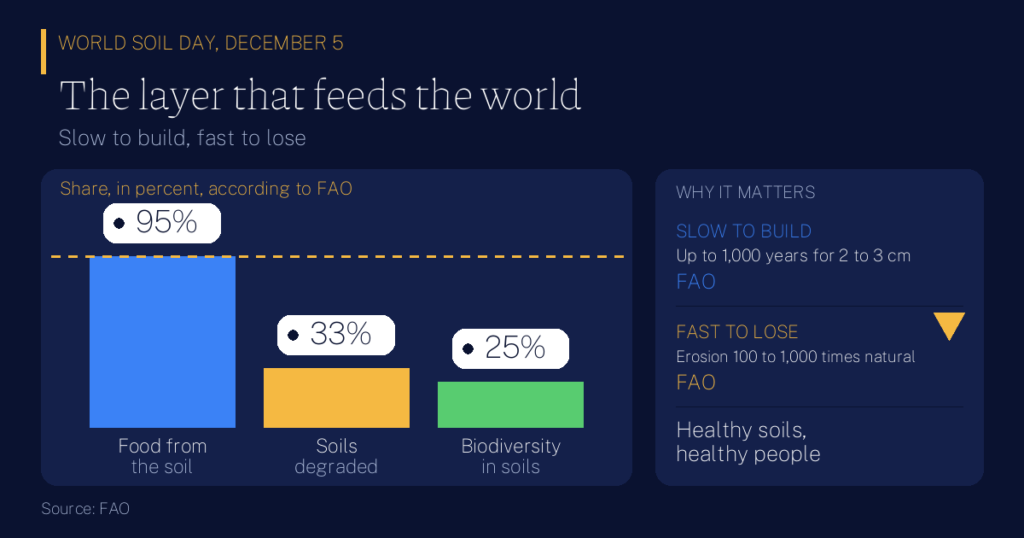
The headline figure is simple: FAO says 95 percent of the food we eat comes from the soil. The warning that goes with it is just as plain. FAO reports that 33 percent of soil is moderately to highly degraded through erosion, loss of soil organic matter, nutrient depletion, acidification, salinization, compaction and chemical pollution. Messages from FAO’s soil erosion symposium add, citing FAO and the Intergovernmental Technical Panel on Soils (2015) and IPBES (2018), that over 90 percent of soils could become degraded by 2050.
- 3.2 billionpeople whose well-being is compromised by erosion and land degradation
- 50%the most that erosion can cut crop yields
- 500+antibiotics derived from soil microbes
- 1,000the number of cities FAO aims to reach by 2030
These are broad estimates built from many national and regional assessments, so read them as orders of magnitude rather than exact counts.
Slow to build, fast to lose
Soil is renewable only on a timescale that no farmer, mayor or minister can wait for. FAO says it can take up to 1,000 years to produce just 2 to 3 centimeters of soil. Erosion works on a far faster clock. FAO’s symposium messages say the equivalent of one soccer pitch of soil is eroded every five seconds, and that on arable or intensively grazed land erosion rates run 100 to 1,000 times higher than natural rates. Erosion can lead to as much as a 50 percent loss in crop yields.
Example 1: the multiplier. Suppose natural processes remove 1 tonne of soil from a hectare in a year. At 100 times that rate the field loses 100 tonnes, and at 1,000 times it loses 1,000 tonnes. The starting tonne is made up for illustration, but the multiples are the range FAO describes.
Who is affected
Soil loss is quiet, so its victims rarely make headlines. FAO’s symposium messages state that soil erosion and land degradation pose a major threat to global food security and to the Sustainable Development Goals, compromising the well-being of at least 3.2 billion people. FAO has also noted that more than 10 million people have abandoned their homes because of environmental issues including soil erosion, desertification, deforestation and drought. Farmers feel the damage first, because thinner and poorer soil means weaker harvests. Families who depend on those harvests feel it next, and so do city residents who buy food grown far away.
Example 2: the dinner table. Picture a table with 20 different foods on it. If 95 percent of food comes from soil, then 19 of those 20 trace back to it, and perhaps only one, such as a fish, does not. The table is invented for illustration, but it shows how little of what we eat escapes the soil’s reach.
Healthy soils for healthy cities
The 2025 theme, Healthy Soils for Healthy Cities, turned attention to the ground beneath pavement. FAO said the day underscores the role soil health plays not only in agriculture but also in shaping more resilient, greener and healthier urban environments. The reason is demographic: two-thirds of the world’s population is projected to live in cities by 2050. FAO cites more than 300 cities worldwide and aims to reach 1,000 cities by 2030.
Example 3: the paved park. A city plans a new park on 10,000 square meters of ground. If construction compacts or seals half of it, only 5,000 square meters remain to take in rain and feed roots. Rain that cannot soak in runs off instead. The numbers are round and illustrative, but they show why urban planners now treat soil as infrastructure.
- 2015Healthy Soils for a Healthy Life
- 2019Stop Soil Erosion, Save Our Future
- 2020Keep Soil Alive, Protect Soil Biodiversity
- 2022Soil, Where Food Begins
- 2024Caring for Soils: Measure, Monitor, Manage
- 2025Healthy Soils for Healthy Cities
The date never moves, but the theme changes every year, and FAO announces it on the official World Soil Day site. You can mark the day by learning what lies under your own feet, joining a local planting or composting event, or asking how your city treats its soil when it builds.
Key Takeaways
- Soil feeds us. FAO says 95 percent of the food we eat comes from the soil.
- It is alive. Soils host a quarter of the planet’s biodiversity and more organisms per tablespoon than there are people on Earth.
- It is under strain. FAO reports that 33 percent of soil is moderately to highly degraded.
- Time is lopsided. Building 2 to 3 centimeters can take up to 1,000 years, while erosion can run 100 to 1,000 times faster than nature.
- The stakes are wide. At least 3.2 billion people have their well-being compromised by erosion and land degradation.
- Cities count too. Healthy urban soils make cities greener and more resilient, which was the 2025 message.
How solid is this? The figures come from FAO pages dated between 2015 and 2025, and several rest on broad global assessments that are updated over time. The 33 percent and 2050 degradation estimates are modeled, and the 3.2 billion figure is as stated by FAO’s symposium. The three worked examples use round, made-up numbers to show an idea. See also World Water Day, the International Days hub and the International Days Calendar.
More in Nature
- FAO Global Soil Partnership. International Year of Soils 2015 and World Soil Day 5 December adopted by the 68th UNGA (December 2013).
- FAO. World Soil Day: About.
- FAO. King Bhumibol World Soil Day Award.
- FAO. Cherishing the ground we walk on (2017).
- FAO. Global Symposium on Soil Erosion: key messages.
- FAO. Healthy soils at the heart of more resilient and greener cities: FAO marks World Soil Day 2025 in Rome.