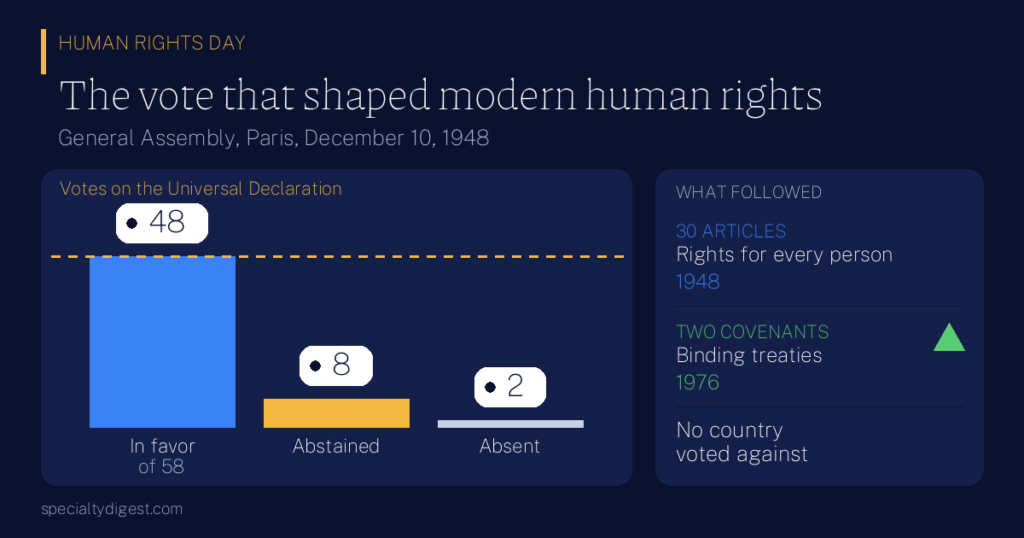
On December 10, 1948, delegates of 58 countries met in Paris to vote on a short text that had no real precedent: a list of rights that belong to every person on Earth, simply because they are human. Not one country voted against it. Today that text, the Universal Declaration of Human Rights, is among the most widely translated documents in the world, and the date of its adoption is Human Rights Day. The day asks a simple question of everyone: do the promises made in 1948 reach the people they were written for?
From the ashes of war to a declaration
The Declaration was a response to catastrophe. The Second World War had shown what happens when governments decide that some people count for less than others. The United Nations Charter of 1945 therefore reaffirmed faith in fundamental human rights, but it did not say what those rights were. In 1946 the new Commission on Human Rights took up the task, and Eleanor Roosevelt, the former First Lady of the United States, chaired the committee that drafted the text. She worked with people from very different traditions, among them Canada’s John Humphrey, who prepared the first draft, France’s Rene Cassin, Lebanon’s Charles Malik and China’s Peng Chun Chang.
The result was adopted by the General Assembly as resolution 217 A (III). Two years later, on December 4, 1950, resolution 423 (V) invited every state and interested organization to observe December 10 as Human Rights Day. The key idea was already in the first article: all human beings are born free and equal in dignity and rights.
What the Declaration actually says
The Declaration has a preamble and 30 articles, and it reads more like a short, clear letter than a legal code. The first two articles set the foundation: dignity, equality and a ban on discrimination based on race, sex, language, religion, opinion, origin or status. Articles 3 to 21 cover civil and political rights, such as life, liberty, a fair trial, freedom of thought, expression and assembly, and taking part in government. Articles 22 to 27 cover economic, social and cultural rights: social security, work, rest, a decent standard of living, education and cultural life. The final three articles speak of the social order needed to make rights real, of duties to the community, and of the rule that no one may use the Declaration to destroy the rights of others.
Example 1: a rest day. Imagine a bakery worker who is scheduled for 7 days a week with no paid leave. Article 24 states that everyone has the right to rest and leisure, including reasonable limits on working hours and periodic holidays with pay. The Declaration does not set the exact number of hours; national law and later treaties do that. The worker’s story shows how a short sentence in 1948 becomes a practical question about a schedule. The numbers here are round and illustrative.
The vote and what it meant
On December 10, 1948, the General Assembly adopted the text with 48 votes in favor, none against and 8 abstentions, while 2 members were absent. The abstaining states were the Soviet Union and five other states of the Soviet bloc (Byelorussia, Czechoslovakia, Poland, Ukraine and Yugoslavia), along with Saudi Arabia and South Africa. Honduras and Yemen did not take part. Since the United Nations then had only 58 members, the result meant that more than four in five governments said yes, and none said no.
- 58UN member states in 1948
- 30articles in the Declaration
- 500+languages and dialects, per OHCHR in 2016
- 9core UN human rights treaties
From a promise to the law
A declaration is a statement of shared standards, not a treaty. Governments knew this, so work began on binding instruments. In 1966 the General Assembly adopted two treaties, the International Covenant on Civil and Political Rights and the International Covenant on Economic, Social and Cultural Rights. Both entered into force in 1976. Together with the Declaration they are known as the International Bill of Human Rights. Seven more core treaties followed, covering racial discrimination, discrimination against women, torture, the rights of the child, migrant workers, persons with disabilities and enforced disappearance, bringing the core set to nine. Each has an expert committee that reviews how countries are doing.
The Declaration also spread through language. OHCHR reported in 2016 that it was available in more than 500 languages and dialects, and the office describes it as the most translated document in the world, a record recognized by Guinness World Records. The reason is practical: a right nobody can read is hard to claim.
Example 2: a missing paper. Suppose a town of 1,000 people has 20 children with no birth certificate, so the school will not enroll them. Article 6 says everyone has the right to be recognized as a person before the law, and Article 26 says elementary education should be free and compulsory. A simple registration drive could reach all 20 children at once. The figures are round and made up for illustration, but this chain from paperwork to schooling is a common one in practice.
Why the day still matters
Rights do not enforce themselves. They advance when people know them, when courts and institutions apply them, and when citizens and governments are willing to be held to them. Many of the topics covered by other observances on this site rest on these articles, from education to health. In 2010 the General Assembly recognized safe drinking water and sanitation as a human right, a story told in World Toilet Day.
Gaps remain, and the Declaration itself says rights belong to everyone, which means the test is always the person at the margins: someone without papers, without a voice, without access to a court. Human Rights Day is a yearly audit of that gap. Individuals who believe their rights have been violated can often turn to national courts, national human rights institutions and, where a country allows it, the UN treaty committees. OHCHR publishes guidance on how to submit a complaint.
Example 3: a rights check. Picture a city council with 10 services, from housing to schools. It asks each department one question: who is still left out? If three departments can name a group, the council has 3 concrete gaps to fix instead of a vague aim. The numbers are illustrative, but the habit of asking who is left out is the spirit of the Declaration.
How the day is marked
OHCHR leads the observance each year with a theme and a global campaign, and the Secretary-General issues a message. The 2025 campaign, titled Human Rights: Our Everyday Essentials, drew attention to rights found in daily life: food, shelter, health, education, safety, work and being heard. Schools, civil society groups, national institutions and governments hold events, and the full text is easy to read at the UN and OHCHR websites in many languages. Themes change annually, so check the official page for the current campaign.
Key Takeaways
- The Declaration came first. On December 10, 1948, 48 of 58 members voted yes and none voted no.
- The day was set in 1950. Resolution 423 (V) invited all states to observe December 10.
- Thirty short articles. They cover dignity, civil and political rights, and economic, social and cultural rights.
- It is a promise, not a treaty. The 1966 Covenants, in force since 1976, and seven further core treaties turned principles into binding law.
- Language is access. OHCHR counted more than 500 translations by 2016.
- Everyone is covered. The test of any society is how it treats the person at the margins.
- You can use it. Read the text, learn the articles that touch your daily life, and know where to seek help.
How solid is this? Dates, vote counts and treaty facts come from United Nations and OHCHR records. The translation count is OHCHR’s 2016 figure and has likely grown. The three worked examples use round, made-up numbers to show an idea. See also World Toilet Day, the International Days hub and the International Days Calendar.
More in Society
- United Nations, Universal Declaration of Human Rights
- United Nations, History of the Declaration
- UN Audiovisual Library of International Law, Procedural history of the Universal Declaration
- OHCHR, Human Rights Day
- OHCHR, Human Rights Day 2025: Our Everyday Essentials
- OHCHR, The Declaration now available in more than 500 languages and dialects (2016)
- OHCHR, The Core International Human Rights Treaties