A woman who survives a long, obstructed labor can face a second ordeal that lasts for years: a childbirth injury called obstetric fistula. It leaves her unable to control the leaking of urine or stool, and in many places it also costs her friends, her family’s support and her livelihood. Yet the condition is fully treatable and preventable. The International Day to End Obstetric Fistula, observed every May 23, asks the world to finish a job that medicine has already shown is possible. It is a close companion of the International Day of the Midwife, because the skilled birth attendants who prevent fistula are the people this day asks us to support.
From a hidden injury to a UN day
Obstetric fistula has long been a hidden injury. UNFPA, the UN sexual and reproductive health agency, describes stigma and shame as common consequences for the women who live with it. In 2003, UNFPA and its partners launched the global Campaign to End Fistula, now active in more than 55 countries. In 2012, the General Assembly adopted resolution A/RES/67/147, which calls on the international community to support efforts to end obstetric fistula. The first International Day to End Obstetric Fistula was marked on May 23, 2013.
The Assembly later raised its ambition. According to UNFPA, a 2018 resolution called for the elimination of obstetric fistula within a decade, and further resolutions followed in 2020, 2022 and 2024. The day is therefore not only a remembrance. It is a progress check on a target the world has set for itself.
What fistula is and why it happens
UNFPA states that obstetric fistula is caused by prolonged, obstructed labor without timely access to medical treatment, and that it is a direct consequence of economic inequalities. Medically, the injury is an opening that forms between the birth canal and the bladder or rectum, which is why a woman cannot hold her urine or stool. UNFPA also cites research indicating that approximately 90 percent of women who develop obstetric fistula deliver a stillborn baby. Grief and shame often arrive together, and that is why the UN treats the condition as a matter of dignity as well as health.
Example 1: the hours that decide. Suppose a woman in labor lives 60 miles from the nearest hospital and the road takes six hours. If labor stalls, those hours are when the damage can occur. If a midwife in her village can recognize trouble early and arrange transport, the same woman may reach a surgeon in time. The distances are round and illustrative, but the lesson is the one the UN stresses: timely access to care is the difference.
The numbers behind the day
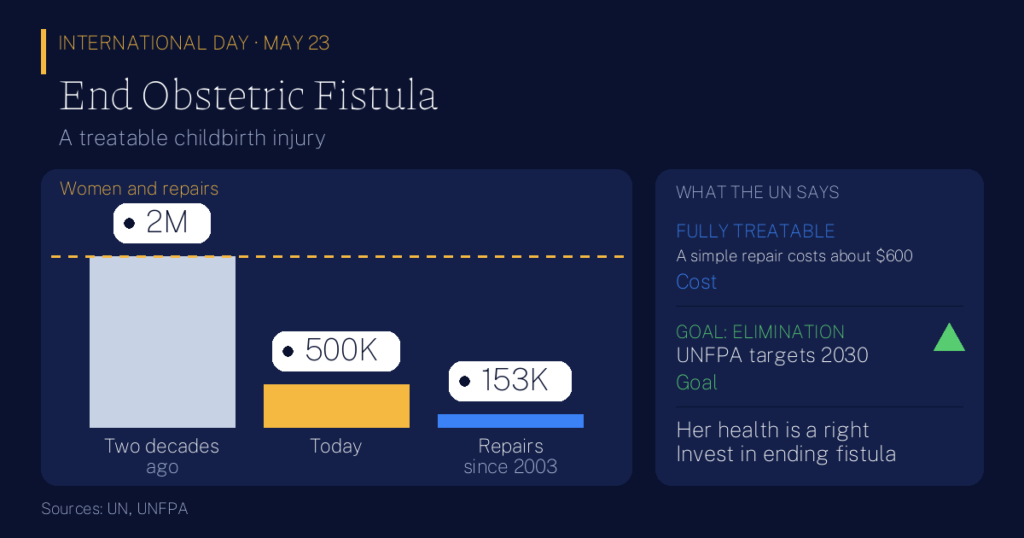
The UN observance page reports that around 500,000 women and girls live with obstetric fistula worldwide, down from 2 million two decades ago. UN News reported in 2025 that those half a million women live in the Global South. The UN background page adds that between 50,000 and 100,000 new cases develop each year, a range that is an estimate and not a count. The same page notes that about 800 women die every day from pregnancy or childbirth complications, and that for every woman who dies, at least 20 more experience a lasting injury or illness.
- 500,000women and girls live with fistula worldwide
- 153,000+repair surgeries supported by UNFPA since 2003
- $600approximate cost of a simple repair, with aftercare
- 55+countries in the Campaign to End Fistula
The fall from 2 million to 500,000 is real progress, and the cost of finishing the work is modest. The UN background page says a patient with uncomplicated fistula can undergo a simple surgery costing $600, including post-operative care and rehabilitation support. Left untreated, fistula costs an estimated $691 million a year in lost productivity, according to the UN observance page.
Example 2: what repairs cost. At $600 each, 100 repairs would cost about $60,000. Scaled to the 153,000 repairs UNFPA has supported, the same arithmetic gives roughly $92 million. These are illustrative calculations at a single round price. Real costs vary by country and by how complicated each case is, but they show how small the price per woman is next to what a lifetime of untreated injury takes.
Who is left behind
Fistula concentrates where health services are thinnest. UNFPA calls it a direct consequence of economic inequalities, and UN News notes that the global shortage of midwives exceeds 900,000, with 500,000 of the missing midwives in Sub-Saharan Africa. A woman who is poor, young, far from a clinic or without a say in her own care is the most likely to be left without help at the critical moment.
Treatment access is the other half. UN News described the work of a fistula center in Bouna, Cote d’Ivoire, and reported 4,400 repairs in that country between 2003 and 2024. Each repair is a woman who can return to family, work and community life. A woman who lives with these symptoms should know that the injury is not her fault and that surgery can help. A local health worker, a midwife or the national health ministry can point her to a treatment center, and UNFPA country offices support fistula programs in many countries.
Prevention starts before labor
The most effective answer is to stop fistula from happening. That means skilled attendance at birth, timely access to emergency obstetric care, and care that does not depend on a family’s wealth. Fistula is also a measure of how well a health system serves its most vulnerable women. Where it disappears, safer birth has usually arrived for everyone.
Example 3: the value of a midwife. Imagine a district with 5,000 births a year and a single midwife for the whole area. Add three trained midwives and a working ambulance, and many more women will have someone at their side when labor goes wrong. The numbers are round and made up, but this is the logic behind the call to close the 900,000 midwife gap.
How the world marks the day
Each May 23, UNFPA, governments, health workers and survivors hold events, share stories and call for funding. The 2025 theme was “Her Health, Her Right: Shaping a Future without Fistula,” and the 2026 theme is “Her health is a right: Invest in ending fistula and childbirth injuries.” UNFPA’s stated goal is elimination by 2030, and UNFPA Executive Director Diene Keita has said that fistula is completely preventable and its elimination is within reach.
- 2025Her Health, Her Right: Shaping a Future without Fistula
- 2026Her health is a right: Invest in ending fistula and childbirth injuries
Key Takeaways
- Fistula is a childbirth injury, not a disgrace. It follows prolonged, obstructed labor without timely care, and the woman is never to blame.
- It is treatable. The UN calls obstetric fistula fully treatable, and a simple repair costs about $600.
- Progress is real. Around 500,000 women live with it today, down from 2 million two decades ago.
- The work is unfinished. UN estimates put new cases at 50,000 to 100,000 a year, and elimination is a stated goal for 2030.
- Inequality is the root cause. Poverty, distance and a shortage of 900,000 midwives leave women without help.
- Prevention beats repair. Skilled birth attendants and emergency obstetric care stop fistula before it starts.
How solid is this? The counts of women living with fistula and of new cases are UN estimates, and the new-case range on the UN background page carries no year. The 153,000 repair figure comes from a UNFPA page updated in August 2026, and the $691 million productivity estimate has no stated year. The three worked examples use round, made-up numbers. See also the International Days hub and the International Days Calendar.
More in Health
- United Nations, International Day to End Obstetric Fistula, observance page
- United Nations, Background on obstetric fistula
- United Nations General Assembly, resolution A/RES/67/147 (2012)
- UN News, A silent crisis: Obstetric fistula affects 500,000 women, yet it is fully treatable (May 2025)
- UNFPA, Obstetric fistula
- UNFPA, International Day to End Obstetric Fistula (2026)