Twice a year the Sun reaches the end of its seasonal journey across our sky and seems to pause before turning back. That pause is the solstice. People have marked it for as long as there are traditions to describe: with bonfires, feasts, music, processions and quiet gatherings at dawn. The United Nations gave the moment its own day. Every year on June 21, the International Day of the Celebration of the Solstice invites the world to notice two things at once, the astronomy that drives our seasons and the human customs that grew around it. The same date also hosts the International Day of Yoga, a reminder of how much the world packs into the longest day of the northern year.
From shared tradition to a UN day
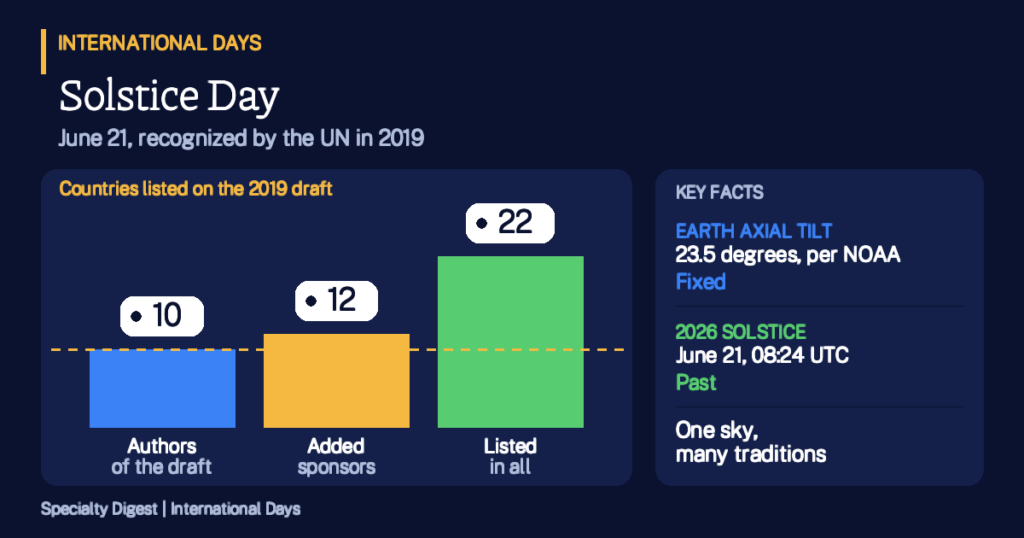
The day did not start as a campaign. It started as a recognition that many peoples, on every inhabited continent, already celebrate the solstices and equinoxes. In 2019 the General Assembly adopted resolution 73/300 and recognized June 21 as the International Day of the Celebration of the Solstice. The draft was tabled on June 20, 2019, with ten countries listed as its authors: Bolivia, Canada, Chile, Cuba, Ecuador, Fiji, Kazakhstan, Paraguay, Peru and Saint Vincent and the Grenadines. Twelve more countries were listed as additional sponsors.
The United Nations explains the thinking in plain terms. It says the Assembly acknowledged that celebrating these events embodies the unity of cultural heritage and centuries-long traditions, and that such celebrations play a significant role in strengthening ties among peoples on the basis of mutual respect and the ideals of peace and good-neighborliness. In short, the day treats a shared sky as a shared inheritance.
What a solstice actually is
A solstice is not a season changing by magic. It is geometry. Earth’s axis is tilted by 23.5 degrees from the plane of its orbit around the Sun, according to NOAA. As Earth circles the Sun, first one hemisphere and then the other leans toward it. At the June solstice the Sun stands directly above the Tropic of Cancer, which lies at 23.5 degrees north of the equator, and NASA describes it as the moment the Sun is at its northernmost position relative to the equator. Six months later, around December 21, the Sun reaches its southernmost position over the Tropic of Capricorn.
The effect on daylight is easy to see. NOAA notes that the solstice days bring the most hours of sunlight in summer and the fewest in winter, that the Sun does not set at all on the summer solstice at the Arctic Circle, and that at the poles it stays above or below the horizon for six months at a time. NASA adds a charming detail: on the June solstice, an observer on the Tropic of Cancer gets a zero-shadow day at noon. It also cautions that the longest day does not line up exactly with the earliest sunrise or the latest sunset.
Example 1: daylight in a town. Suppose a town in the northern temperate zone gets about 15 hours of daylight on the June solstice and about 9 hours on the December one. The gap is 6 hours, so the summer day gives that town two-thirds more light to work with. The numbers are round and illustrative, but the pattern is the reason so many communities planned harvests, markets and festivals around the Sun.
The date rule
The United Nations fixes the observance on June 21. The astronomical solstice is a precise moment that can shift by a day or so from year to year, and the UN itself describes the event as happening around June 21. In 2026, NASA lists it as June 21 at 08:24 UTC, which is 1:24 a.m. Pacific time. In other years the moment may fall on a neighboring date in some time zones, but the UN day stays on June 21.
Fire, harvest and heritage
The UN page says solstices and equinoxes symbolize the fertility of the land, agricultural and food production systems, cultural heritage and their millenary traditions, and it notes that many cultures celebrate various combinations of the solstices, the equinoxes and the points between them. One example it gives is on UNESCO’s Representative List of the Intangible Cultural Heritage of Humanity: the summer solstice fire festivals of the Pyrenees, inscribed in 2015 and shared by France, Spain and Andorra.
UNESCO describes the practice this way. On the night of the summer solstice, people from neighboring towns and villages carry flaming torches down the mountains to light traditionally built beacons. The descent is a special moment for young people, marking a passage toward adulthood. The festival includes folklore and communal dining, renews social ties and a sense of belonging, and the next morning people collect embers or ashes to protect their homes or gardens. UNESCO names the family as the main place where the tradition is passed on.
Example 2: a torchlit descent. Imagine three mountain villages that each send 40 torchbearers down to a shared beacon. That is 120 torches converging on one fire. The figures are made up for illustration, yet the picture shows what UNESCO emphasizes: no single village owns the event, and the shared fire is what turns neighbors into a community.
Why a day about the Sun matters
It may seem odd to give a United Nations day to something as old as the sky. The reason is in the resolution’s own wording: shared celebrations build mutual respect. The UN page also lists two related documents alongside the resolution, the United Nations Declaration on the Rights of Indigenous Peoples and the UNESCO Universal Declaration on Cultural Diversity. That pairing signals how the day is meant to be read. Solstice traditions belong to many peoples, including Indigenous communities, and protecting the space for them to be practiced is part of protecting cultural diversity.
The solstice also connects people to the food they eat. Because the Sun drives growing seasons, the same pattern that inspires festivals explains planting calendars and harvest rituals. When the UN links solstices to the fertility of the land and to agricultural and food production systems, it is pointing at that old partnership between astronomy, farming and community life.
How people can mark it
The resolution does not prescribe a program or name a lead agency, and the UN page lists no annual theme. That openness is part of the design. Communities decide for themselves, and the day sits comfortably with a bonfire, a concert, a hike to watch the sunrise, a class on the tilt of Earth’s axis, or a family meal that follows a recipe older than anyone at the table can trace.
Example 3: a classroom plan. A school of 200 students could split into five groups of 40. Each group researches one seasonal tradition from a different region, builds a shadow clock in the schoolyard, and shares findings at a short assembly. That is five traditions, one sky and one shared afternoon. The numbers are illustrative, and the idea is simple: the solstice is a rare topic that combines science, history and neighborliness in one activity.
Key Takeaways
- The day is fixed on June 21. The UN General Assembly recognized it in resolution 73/300, adopted in 2019.
- The cause is geometry. Earth’s axis is tilted 23.5 degrees, so the Sun appears to move between the two tropics each year.
- The moment shifts, the day does not. In 2026 the solstice arrived on June 21 at 08:24 UTC, but the UN date stays put.
- Tradition is the point. The UN says these celebrations embody the unity of cultural heritage and strengthen ties among peoples.
- Living heritage is real. UNESCO inscribed the Pyrenees solstice fire festivals in 2015, shared by France, Spain and Andorra.
- No single script. The day has no set theme or program, so every community can mark it in its own way.
How solid is this? The date, resolution symbol and UN wording come from the United Nations observance page. The sponsor counts are the names listed on the draft resolution record and may not match the final list of co-sponsors. Astronomy figures come from NOAA and NASA, and the 2026 solstice time is NASA’s published value. The three worked examples use round, made-up numbers to show an idea. See also the International Days hub and the International Days Calendar.
More in Society
- United Nations, International Day of the Celebration of the Solstice
- United Nations Digital Library, draft resolution addendum A/73/L.92/Add.1 (June 20, 2019)
- United Nations Meetings Coverage, General Assembly recognizes June 21 as solstice day (2019)
- UNESCO, Summer solstice fire festivals in the Pyrenees
- NOAA NESDIS, What Is a Solstice?
- NASA Science, Tropical Solstice Shadows (2026)
- NASA Science, What’s Up: June 2026