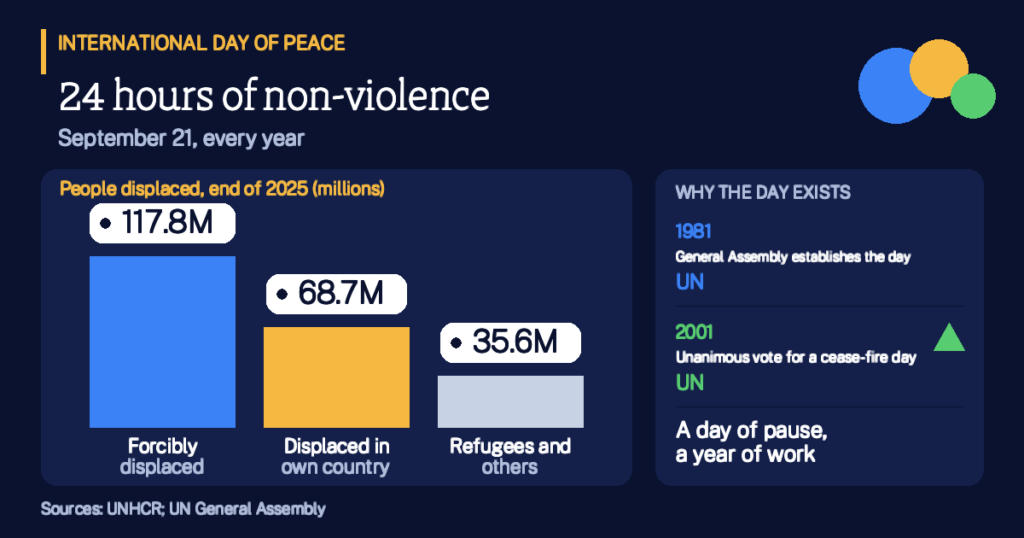
Most holidays ask people to celebrate. The International Day of Peace asks for something harder: a pause. For one day each year, the United Nations invites the whole world to stop fighting. That request sounds modest, even naive, until you see what it is trying to do. It gives every person, community and government a shared moment to ask whether peace is something we merely hope for or something we actively build.
How a day of peace was born
The day has two origin points. In 1981, the General Assembly established it through resolution A/RES/36/67, which also proclaimed an International Year of Peace. The idea was to devote a specific day to strengthening the ideals of peace, both within and among nations and peoples.
Two decades later, in 2001, the Assembly voted unanimously on resolution A/RES/55/282 to designate the day as a period of non-violence and cease-fire. The UN describes the aim as 24 hours of non-violence and invites all nations and people to honor a cessation of hostilities during the day. The observance is held on September 21 each year.
What “peace” means here
Peace is often defined as the absence of war, but the UN treats it as more than silence between battles. Maintaining international peace and security is the first purpose named in Article 1 of the UN Charter, and the Charter links it to friendly relations among nations and to respect for human rights. Each year’s theme shows the broader view, tying peace to subjects such as equality, justice, education and the ways people live together. The UN publishes the current theme on its official observance page, and it changes from year to year, so check that page for the latest.
This wider meaning matters because wars rarely begin with a single shot. They grow from exclusion, fear, unequal treatment and broken trust. A day that asks for non-violence in the narrowest sense also invites everyone to look at what makes violence more likely.
The numbers behind the day
The clearest measure of how far the world is from peace is human displacement. According to UNHCR, the UN refugee agency, about 117.8 million people were forcibly displaced worldwide at the end of 2025. For comparison, UNHCR reported 117.3 million at the end of 2023. The total has barely moved in two years, which is why the day still has work to do.
There is one piece of news that deserves care. UNHCR’s report says global forced displacement fell during 2025, for the first time in a decade. The agency also estimates that the figure remained at a similar level, or slightly lower, as of the end of April 2026, at roughly 117 to 118 million people. A fall is welcome, but a number this large is still a measure of suffering.
Example 1: what a million looks like. Suppose a country of 10 million people saw one in ten forced from their homes. That is 1 million people, enough to fill a large city. The numbers here are round and illustrative, but they show why a headline total of more than 117 million is so hard to picture.
Why a single day can matter
Critics ask whether 24 hours can change a war. The honest answer is that no day, by itself, ends a conflict. What a pause can do is create room. Short truces have a long history of letting aid reach people, letting a family cross to safety, and letting negotiators see that stopping is possible. The UN’s invitation to honor a cessation of hostilities rests on that practical idea.
Example 2: a one-day pause. Imagine a town where fighting has blocked a road for weeks. If both sides honor a day of calm, a convoy of 20 trucks could bring food and medicine through. The figures are made up to show the principle, not to describe any real place. The point is that a pause can turn an abstract hope into something people can use.
Who bears the cost
Conflict does not fall evenly. According to UNHCR, 35.6 million people were refugees or in other situations of international protection need at the end of 2025, and adding about 6 million Palestine refugees under UNRWA’s mandate brings the figure to 41.6 million. Many more are displaced inside their own countries. Children miss school, health services are interrupted and people lose homes, income and community. Recovery can take many years after the shooting stops.
The need for peace is also tied to everyday systems that communities share. Safe water and sanitation, schools and clinics all depend on stability, which is why peace work overlaps with development work. The same logic that drives World Water Day applies here: shared resources are easier to protect when people trust one another.
How the day is marked
The UN marks the day with ceremonies and messages from its leaders, and schools, faith groups, city governments and community organizations hold their own events around the world. Many observe a minute of silence, hold a dialogue between groups that rarely talk, or take on a small project that brings neighbors together. The common thread is action at every scale.
Example 3: a school’s day. A school of 500 students chooses to spend the morning on a listening exercise: students pair up, one speaks for two minutes, and the other repeats back what they heard. If 250 pairs complete it, that is 250 small conversations that start with listening. The numbers are round and illustrative, yet they show how a global call can become a classroom habit.
Key Takeaways
- It is a day of pause. The UN asks for 24 hours of non-violence and cease-fire each September 21.
- The idea has two roots. The General Assembly created the day in 1981 and gave it its cease-fire meaning by unanimous vote in 2001.
- Peace is more than no war. It links to justice, equality and trust between people.
- The human cost is vast. UNHCR estimated 117.8 million forcibly displaced people at the end of 2025.
- There is a small sign of change. Displacement fell during 2025 for the first time in a decade, yet the total remains close to its 2023 level.
- A pause creates room. Even a short truce can let aid, safety and talks move forward.
- Everyone has a part. Peace is practiced in homes, schools and communities long before it is signed in treaties.
How solid is this? The history comes from the UN’s own observance page and the two General Assembly resolutions. Displacement figures are UNHCR estimates for the end of 2025 and are revised in later reports, and the internal displacement number is an Internal Displacement Monitoring Centre estimate. The three worked examples use round, made-up numbers. See also the International Days hub and the International Days Calendar.
More in Society
- United Nations. International Day of Peace.
- UN General Assembly. Resolution A/RES/36/67, International Year of Peace and International Day of Peace (1981).
- UN General Assembly. Resolution A/RES/55/282, International Day of Peace (2001).
- UNHCR. Global Trends: Forced Displacement in 2025 (2026).
- UNHCR. Global Trends, 2023 figures.
- United Nations. Charter of the United Nations, Article 1.