The world is adding older people faster than at any time in recorded history. The International Day of Older Persons, observed every October 1, asks whether health systems, economies and communities are ready for them. It is not a day for sentiment. It is a yearly check on whether people who have lived long lives can still count on care, income, safety and a voice. It sits close to World Alzheimer’s Day, because longer lives bring great gifts and some of health’s hardest challenges together.
From Vienna to a yearly observance
The idea has a clear paper trail. The 1982 World Assembly on Ageing adopted the Vienna International Plan of Action on Ageing. On December 14, 1990, the General Assembly adopted resolution 45/106 and designated October 1 as the International Day of Older Persons. A year later, resolution 46/91 gave governments the United Nations Principles for Older Persons. In 2002 the Madrid International Plan of Action set the framework that still guides national policy. In December 2020 the Assembly proclaimed 2021 to 2030 the UN Decade of Healthy Ageing, a ten-year effort to improve the lives of older people, their families and communities.
What “older” means
Different bodies draw the line differently. WHO and the UN’s ageing statistics count people aged 60 and older, while the UN Population Division’s headline projection counts people aged 65 or older. Neither is a law of nature. It is a statistical convention that lets countries compare trends. Ageing is also not one experience: a healthy 62-year-old who still works and a frail 92-year-old who needs daily help face very different questions, and good policy has to serve both.
The numbers behind the day
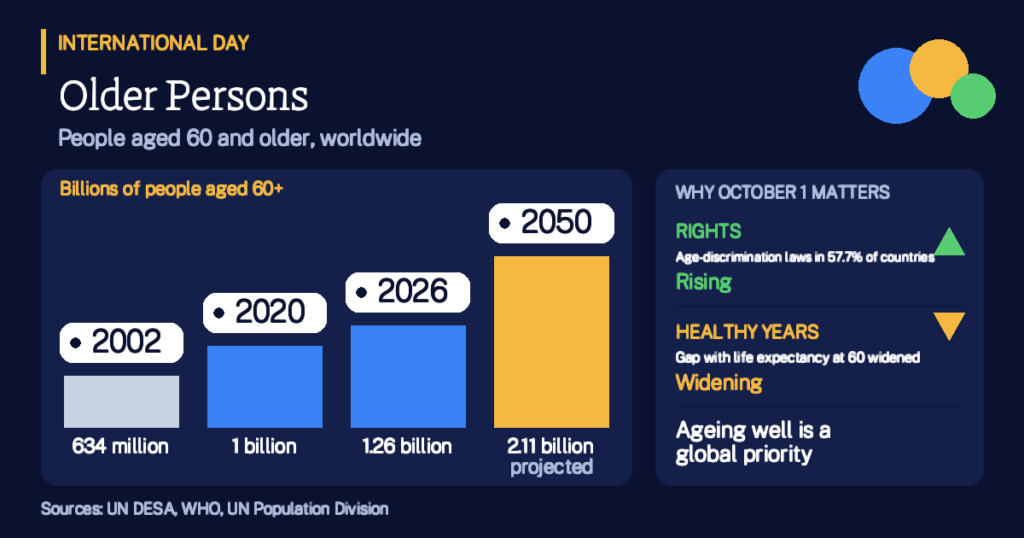
According to UN DESA, about 634 million people were aged 60 or older in 2002. WHO reports that the figure passed 1 billion in 2020, the year people over 60 outnumbered children younger than 5. In 2026 the count stands at about 1.26 billion, or 15.2 percent of humanity. By 2050 it is projected to reach 2.11 billion, or 21.8 percent. The oldest group grows fastest: people aged 80 and older number about 174 million in 2026 and are projected to reach 446 million in 2050.
The UN Population Division looks at the same trend from the other end of life. Its 2024 projections say that by 2080 people aged 65 and older will outnumber children under 18, and that the 65-plus group will reach 2.2 billion by the late 2070s.
Example 1: a town in transition. Imagine a town of 100,000 where 15,000 residents are 60 or older. If the town stays the same size but the older share rises to 22 percent, it will have 22,000 older residents, 7,000 more than today. Those extra neighbors will need more clinic visits, safer sidewalks and more home care. The numbers are round and illustrative, but they show why planners cannot wait.
- 1.26 billionpeople aged 60 or older in 2026 (UN DESA)
- 2.11 billionprojected aged 60 or older in 2050
- 446 millionprojected aged 80 or older in 2050
- 80%of older people expected in low- and middle-income countries in 2050 (WHO)
Where ageing is happening
Ageing is often pictured as a rich-country story, and Japan, where about 30 percent of people are already over 60, fits that picture. But WHO projects that by 2050 about 80 percent of older people will live in low- and middle-income countries. Those countries are ageing at a time when their health, pension and care systems are still being built. WHO also says the share of people over 60 will nearly double between 2015 and 2050, from 12 percent to 22 percent.
More years, but healthy ones?
Longer life only matters if the added years are good ones. WHO notes that the proportion of life lived in good health has remained broadly constant, which suggests that many added years come with illness or disability. The 2026 midpoint report on the Decade of Healthy Ageing found that between 2000 and 2023 the gap between life expectancy and healthy life expectancy at age 60 widened. It also noted that about 71 percent of COVID-19 excess deaths between 2020 and 2023 were among people aged 60 and older.
The same report tracked what countries are doing about it, and the results are mixed.
Example 2: the hidden cost of care. Suppose a daughter spends 20 hours a week helping her 78-year-old father with meals, bathing and appointments. Over 50 weeks that is 1,000 hours. At an illustrative value of $15 an hour, the unpaid work is worth $15,000 a year, and it is time she may not spend on paid work. The figures are made up and rounded, but they show why the 2024 theme stressed strong care and support systems.
Rights, dignity and safety
The day’s themes have kept returning to rights. The 2024 theme was “Ageing with Dignity: The Importance of Strengthening Care and Support Systems for Older Persons Worldwide.” The 2025 observance was titled “Older Persons Driving Local and Global Action: Our Aspirations, Our Well-Being, Our Rights.” Progress on rights is visible in law: the share of countries with age-discrimination legislation rose from 44.5 percent in 2018 to 57.7 percent, according to the midpoint report.
Safety is part of dignity. WHO’s fact sheet says about 1 in 6 people aged 60 and older, or 15.7 percent, experienced some form of abuse in community settings in the past year, based on a 2017 review of 52 studies in 28 countries. Data on abuse in institutions are scarce. WHO projects that about 320 million people could be affected by 2050. Anyone worried about an older person can contact local adult protective or social services, a health professional, or emergency services.
- 2024Ageing with Dignity: strengthening care and support systems
- 2025Older Persons Driving Local and Global Action: Our Aspirations, Our Well-Being, Our Rights
How the day is marked
The date is fixed at October 1, but the United Nations holds its annual commemoration on varying days: October 1 in 2025, October 7 in 2024, and a 2026 event listed for October 8. The 2026 theme is not stated on the UN pages checked for this article. Around the world, governments, health agencies and community groups use the day for forums, health screenings and campaigns against ageism.
Example 3: a neighborhood check. Imagine a library asks 40 older neighbors what keeps them from visiting. If 12 name broken sidewalks and 8 name signs that are too small to read, half the group faces barriers that a city can fix with modest, targeted work. The numbers are illustrative, yet the method of asking older people first is exactly what the Day encourages.
Key Takeaways
- The Day has a clear legal basis. Resolution 45/106 of December 14, 1990 set October 1 as the International Day of Older Persons.
- The older population is growing fast. People aged 60 and older rise from about 1.26 billion in 2026 to a projected 2.11 billion in 2050.
- The oldest group grows fastest. People aged 80 and older are projected to reach 446 million in 2050.
- Ageing is a global story. WHO expects about 80 percent of older people to live in low- and middle-income countries in 2050.
- Healthy years matter more than total years. The gap between life expectancy and healthy life expectancy at 60 widened from 2000 to 2023.
- Rights and safety are part of the agenda. About 1 in 6 older people report community abuse in a year, and 57.7 percent of countries now have age-discrimination laws.
- Ask older people first. The best plans start with what older neighbors say they need.
How solid is this? Population counts and projections are UN and WHO estimates that are revised with each update, and the two bodies use slightly different age cutoffs and base years. The abuse prevalence figure comes from a 2017 review, and WHO says institutional data are scarce. The three worked examples use round, made-up numbers to show an idea. See also the International Days hub and the International Days Calendar.
More in Society
- United Nations, International Day of Older Persons
- UN DESA, International Day of Older Persons (UNIDOP)
- UN DESA, 2025 UNIDOP event page
- WHO, Ageing and health fact sheet (October 2025)
- WHO, Abuse of older people fact sheet (June 2024)
- UN Population Division, World Population Prospects 2024: Ten key messages
- WHO, UN Decade of Healthy Ageing midpoint report (October 1, 2026)