Some of a community’s most precious possessions cannot be locked in a vault or hung on a wall. A grandmother’s lullaby, the steps of a harvest dance, the way a village reads the sky before planting: these exist only as long as people keep practicing them and teaching them to the young. The International Day of the Intangible Cultural Heritage, observed every year on October 17, asks the world to notice this living inheritance and to remember that it can fade within a single generation. It is one of the newest days in the international calendar, and its date carries a story worth knowing.
A day born from a treaty
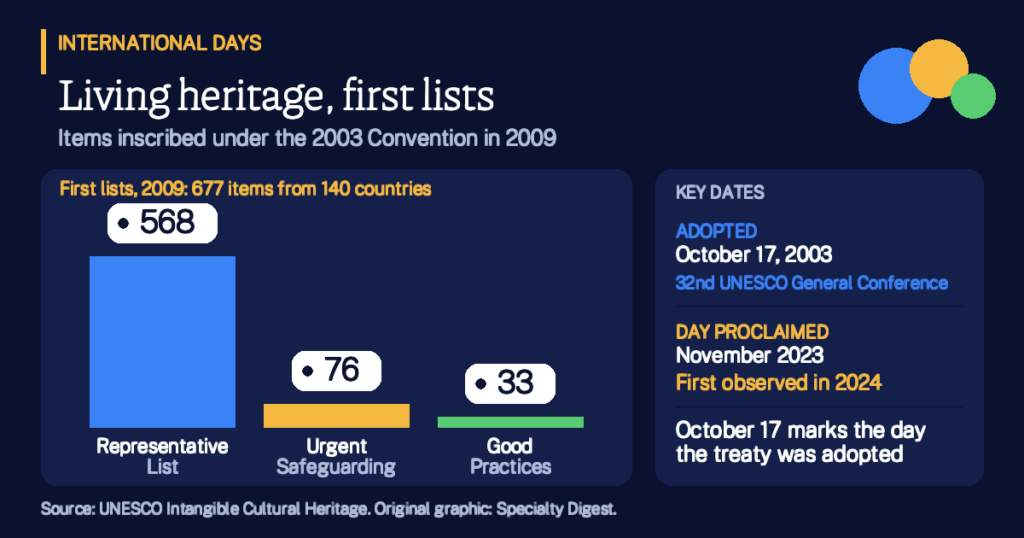
The date was chosen with care. On October 17, 2003, the 32nd session of the UNESCO General Conference, meeting in Paris, adopted the Convention for the Safeguarding of the Intangible Cultural Heritage, usually called the 2003 Convention. It entered into force on April 20, 2006, for the thirty States that had ratified it by January 20, 2006.
Three years later came the first lists. In 2009, 568 elements from 136 countries were inscribed on the Representative List, 76 elements from 40 countries on the Urgent Safeguarding List, and 33 programs, projects and activities from 31 countries in the Register of Good Safeguarding Practices. In all, 677 elements from 140 countries.
Two decades after the treaty, UNESCO gave it a day of its own. At its 42nd session, in November 2023, the General Conference proclaimed October 17 as the International Day of the Intangible Cultural Heritage. The first observance took place in 2024, and UNESCO calls the 2026 edition the third. Note that this is a UNESCO day, proclaimed by the organization’s own General Conference rather than by the UN General Assembly.
What counts as living heritage
The Convention defines intangible cultural heritage as the practices, representations, expressions, knowledge and skills that communities, groups and, in some cases, individuals recognize as part of their cultural heritage. The key word is recognize. The people who carry a tradition decide what it means to them; outside experts do not. The Convention also describes this heritage as something communities keep recreating in response to their surroundings, which is why it is called living.
UNESCO groups it into five broad domains, and says the list is meant to be inclusive rather than exclusive. A single tradition often touches several at once.
Example 1: a weaving village. Imagine a village where 20 elders know a pattern that tells the story of local floods and harvests. Only 5 young people are learning it. The cloth is the visible part; the pattern, the stories and the skill of the hands are the heritage. The numbers are round and illustrative, but they show why the work is about people, not objects.
Safeguarding is not freezing
The treaty speaks of safeguarding, which means measures that keep heritage viable: documenting it, passing it on through formal and nonformal education, and reviving it where it is fading. It does not mean freezing a tradition in a glass case. A song that changes with each generation is alive. A song performed only for visitors, with no one left who sings it at home, may be close to gone.
The Convention gives that work three tools. The Representative List shows the diversity of living heritage and builds awareness. The Urgent Safeguarding List is for elements that need immediate action to survive. The Register of Good Safeguarding Practices shares programs that have worked.
Example 2: a fading song. Suppose a language community has 40 fluent singers of a ceremonial song, and most are over 70. A recording project, a weekly class led by 4 of the singers and a school visit each term could pass the song to 30 learners within a few years. The numbers are made up for illustration. The point is that safeguarding means building the chain of teaching, not only taping the last singers.
The numbers behind the day
Heritage work now runs at a large scale. The Intergovernmental Committee for the Safeguarding of the Intangible Cultural Heritage met from December 8 to 12, 2025, in New Delhi, India. Its agenda listed 54 nominations for the Representative List, 11 for the Urgent Safeguarding List, 2 transfer requests and one proposal for the Register, a total of 68 files to examine. Those are files examined, not elements added; the outcomes are recorded in the Committee’s decisions.
- 677items on the first lists in 2009
- 140countries represented on those lists
- 68files examined by the Committee in December 2025
- 100+activities featured for the 2026 day
Why it matters, and who is left behind
Living heritage is carried by people, so it is only as safe as the chain of people who hold it. When elders die before passing on a skill, when young people move away for work, or when a language loses its last everyday speakers, the loss is quiet and hard to reverse. Nothing falls down and no building burns, so no one notices until it is too late.
Heritage also holds knowledge that serves everyone. The fourth domain covers knowledge and practices concerning nature and the universe, such as how communities read seasons, manage water or use plants. Food traditions belong here too: the Mediterranean diet, which has its own observance on November 16, is on the Representative List. Languages, another carrier of heritage, are honored on days such as the World Day of Romani Language.
The people most at risk of being overlooked are often the bearers themselves: rural elders, minority language speakers, women who carry craft and food traditions, and communities with little money to document what they know. That is why the Convention puts communities, groups and individuals at the center of identifying their own heritage.
How the day is marked
There is no single ceremony. UNESCO invites States Parties, Category 2 centers, UNESCO Chairs, accredited NGOs and communities to organize their own events. In 2026, more than 100 activities were featured on the day’s web page as part of a global online campaign. They included a canoe trip on the River Ebro in Spain, an embroidery workshop in Poznan, Poland, folk dance gatherings in Santa Catarina, Brazil, and a seminar in Uzbekistan on knowledge of nature and water management. The first edition, in 2024, included a webinar on artificial intelligence and intangible heritage.
Example 3: a school project. A class of 30 students each interview one older relative or neighbor about a song, recipe or craft, with permission, and the class builds a small shared archive. That is 30 recorded memories and 30 conversations across generations. The numbers are illustrative, but the method is how living heritage actually survives: one person asking another.
Key Takeaways
- The date is the treaty’s birthday. October 17 marks the 2003 adoption of the Convention for the Safeguarding of the Intangible Cultural Heritage.
- The day is young. UNESCO proclaimed it in November 2023, first observed it in 2024, and held its third edition in 2026.
- Heritage lives in people. It is practices, knowledge and skills, recognized by the communities that carry them.
- Five domains cover it. Oral traditions, performing arts, social practices, knowledge of nature and craftsmanship.
- Safeguarding means keeping it alive. Teaching, documentation and revival matter more than preservation under glass.
- You can take part. Ask an elder what they know, record it with permission, and help pass it on.
How solid is this? Dates, list figures and the Committee agenda come from UNESCO pages. The 2009 figures are the first inscriptions, not today’s totals, and the December 2025 numbers count files examined, not elements inscribed. The three worked examples use round, made-up numbers to show an idea. See also the International Days hub and the International Days Calendar.
More in Society
- UNESCO, International Day of the Intangible Cultural Heritage
- UNESCO ICH, International Day of the Intangible Cultural Heritage
- UNESCO ICH, Communities around the world celebrate the 2026 International Day (October 17, 2026)
- UNESCO ICH, Today we celebrate the first International Day (October 17, 2024)
- UNESCO Legal Affairs, Convention for the Safeguarding of the Intangible Cultural Heritage (2003)
- UNESCO ICH, 20th anniversary 2003-2023
- UNESCO ICH, 20th session of the Intergovernmental Committee, New Delhi (December 2025)