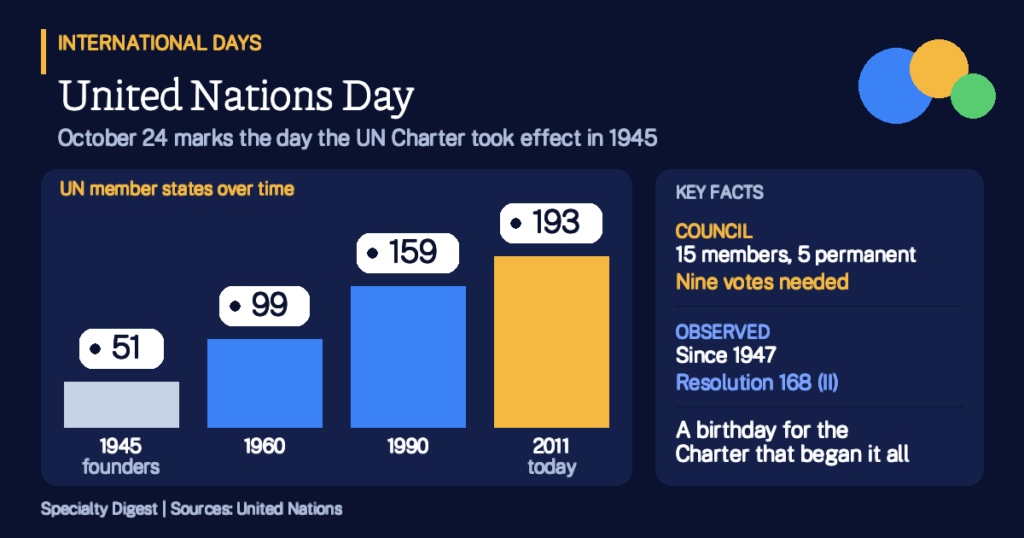
Most holidays honor a person, a battle or a harvest. United Nations Day honors a document. On October 24, 1945, the Charter of the United Nations came into force, and an organization that had existed only on paper became real. The day is the birthday of the UN, and it is a good moment to ask a plain question: what is this institution for, how does it work, and why do so many of the world’s other observances trace back to it? It is a quieter cousin of the International Day of Peace, which looks at one of the UN’s goals, while this day looks at the whole machine.
The day the Charter came alive
The Charter was drafted and signed at the San Francisco conference and signed on June 26, 1945, but a treaty does nothing until enough countries approve it. The Charter itself said it would take effect once China, France, the Soviet Union, the United Kingdom and the United States, plus a majority of the other signatories, had ratified it. That threshold was reached on October 24, 1945, and the United Nations officially began. Fifty states signed on the first day; Poland, which had not been able to send a delegate, signed soon after, which is why the founding list has 51 names.
The idea of a day to mark the occasion came two years later. In 1947 the General Assembly, in resolution 168 (II), declared October 24 to be United Nations Day. In 1971 it went a step further and recommended that member states treat the date as a public holiday. In 2025 the organization marked its 80th anniversary, and in 2026 it marks 81 years.
What the Charter actually says
The Charter opens with the words “We the peoples of the United Nations,” and its aims are stated in its first article: to maintain international peace and security, to develop friendly relations among nations, to cooperate in solving economic, social, cultural and humanitarian problems and in promoting human rights, and to serve as a center where nations harmonize their actions. It has 111 articles. It is both a treaty and a constitution, because it binds members and also builds the bodies that run the organization.
- 51founding members in 1945
- 193member states today
- 111articles in the Charter
- 6principal organs created by the Charter
From 51 to 193
The United Nations began as a club of 51 and became something close to universal. Membership passed 76 in 1955, when a large group of states was admitted together. It reached 99 in 1960, the year many African countries became independent, and 159 by 1990. The most recent addition was South Sudan, welcomed as the 193rd member in July 2011. Put another way, the founding members now make up only about a quarter of the membership.
Example 1: counting votes. In the General Assembly every member has one vote, whether it is among the largest countries or the smallest. Important questions need a two-thirds majority of members present and voting. Suppose 180 members are present and vote. Two thirds of 180 is 120, so a resolution on an important question needs 120 yes votes. The numbers are round and illustrative, but the rule is real.
How the machine is built
The Charter created six principal organs. The General Assembly is the main deliberative body, where all members sit. The Security Council has 15 members, five of them permanent, and carries the main responsibility for peace and security. The Economic and Social Council coordinates development work, the International Court of Justice at The Hague settles legal disputes between states, and the Secretariat, led by the Secretary-General, runs the daily work. The sixth, the Trusteeship Council, supervised territories on the path to independence and suspended its operations in 1994 after its work was done.
Example 2: the Security Council count. A Council decision on a substantive matter needs nine of the 15 votes, and none of the five permanent members may vote against it. Imagine ten members vote yes, but one permanent member votes no. The proposal fails despite a clear majority. This is the veto, and it is the feature of the Charter most often debated when people discuss reform. The votes in this example are illustrative.
Why it matters, and what remains unsettled
The UN is the reason that so many shared promises exist. Its agencies run health campaigns, its humanitarian bodies respond to disasters, its peacekeepers have served in operations since 1948, and its member states negotiated the Universal Declaration of Human Rights in 1948, which is celebrated each year on Human Rights Day. Most of the international days on this site were created by its General Assembly or by its specialized agencies such as UNESCO and WHO.
It is also an institution under debate. Critics and supporters alike point to the veto, to the pressure on funding and to the gap between what the Charter promises and what the Council can deliver. The 80th anniversary in 2025 was framed as a moment for reflection and renewal under the banner UN80. A fair reading is that the organization is both indispensable and imperfect, and that the Charter’s own words give citizens and governments the tools to ask for more.
Example 3: sharing the bill. The regular budget is shared among members according to their capacity to pay. Imagine a $100 million project. A large economy assessed at 20 percent would pay $20 million, while a small economy assessed at 0.01 percent would pay $10,000. The percentages are made up for illustration, but the principle of ability to pay is how the UN spreads costs.
How the day is marked
United Nations Day is observed with flag ceremonies, concerts, school lessons, open houses and speeches by the Secretary-General, and since 1971 member states have been invited to treat it as a public holiday. The date is shared with World Development Information Day, which focuses on how information supports development. Simple ways to join in include reading the Charter’s preamble, finding out which UN body works in your region, or asking a teacher or local library to host a short model assembly where each student speaks for one country.
Key Takeaways
- The day marks a document. On October 24, 1945, the UN Charter took effect after ratification by the five founding powers and a majority of other signatories.
- The date was chosen in 1947. General Assembly resolution 168 (II) designated October 24 as United Nations Day.
- Membership grew nearly fourfold. From 51 founders to 193 members, with South Sudan joining in 2011.
- Six organs share the work. The General Assembly, Security Council, Economic and Social Council, Trusteeship Council, International Court of Justice and Secretariat.
- Votes work differently in each body. One vote per state in the Assembly, and nine of 15 votes with no permanent veto in the Council.
- The UN is debated as well as celebrated. Veto power and funding are recurring reform topics, and 2025 brought the UN80 anniversary conversation.
- Anyone can take part. Read the Charter, follow one UN agency, or run a classroom assembly on October 24.
How solid is this? Dates, membership counts and organ descriptions come from United Nations pages and are stable facts, though membership and Council composition can change and the UN80 reform agenda is still evolving. The three worked examples use round, made-up numbers to show an idea. See also the International Days hub and the International Days Calendar.
More in Society
- United Nations. United Nations Day.
- United Nations. Happy United Nations Day! UN Yearbook.
- United Nations. UN Charter.
- United Nations. Growth in United Nations membership.
- UN News. UN welcomes South Sudan as 193rd Member State (2011).
- United Nations. Main Bodies and Membership of Principal UN Organs.
- United Nations. UN 80th anniversary.