Every app, map, bank transfer and school portal runs on instructions that a person once wrote. Coding is the craft of writing those instructions, and World Coding Day, observed every year on October 29, asks a simple question: who gets to learn it? UNESCO, which leads the day, frames coding as a new kind of literacy for the age of artificial intelligence. Reading and writing let people take part in a society of books. Coding lets people take part in a society of software. The day was first celebrated in 2024, which makes it one of the youngest observances on the international calendar, and its message is already clear: the ability to shape technology should not belong to a few countries, a few schools or one gender.
Where the day came from
UNESCO describes the origin in one sentence: recognizing the importance of coding to our digital world, its Member States designated October 29 as World Coding Day. It was celebrated for the first time in 2024. Because the day is young, its traditions are still forming, and the official page does not list yearly themes. What it does offer is a clear argument. UNESCO calls coding a language of logic, creativity and problem-solving, and says that learning it lets people co-create technology rather than only use it. In that view, a learner who can code becomes an active creator of inclusive and ethical digital futures instead of a passive consumer of tools built elsewhere.
UNESCO’s Director-General, Khaled El-Enany, puts the equity point plainly: “Ensuring universal access to coding education is essential, particularly for women and girls who remain underrepresented in this field.”
What coding actually is
Coding is often pictured as rows of strange symbols, but the core idea is older and simpler. A program is a precise list of steps that a machine can follow. The skill lies less in typing than in thinking: deciding what problem to solve, cutting it into small ordered actions, and checking that each one does what you expect. Teachers call this computational thinking, and it travels well beyond computers. A person who plans a recipe, a bus route or a budget in clear steps is using the same habit of mind.
Example 1: the lunch line. A school wants students to pick lunch without waiting. A beginner decides the problem (too many people at one counter), breaks it into steps (choose a meal, confirm the choice, show a pickup number), writes a short program that does each step, and then tests it with ten classmates. Two of them tap the wrong button, so the beginner redesigns the screen. The scenario is illustrative, but the loop of define, break down, write and test is exactly what the day invites learners to practice.
The numbers behind the day
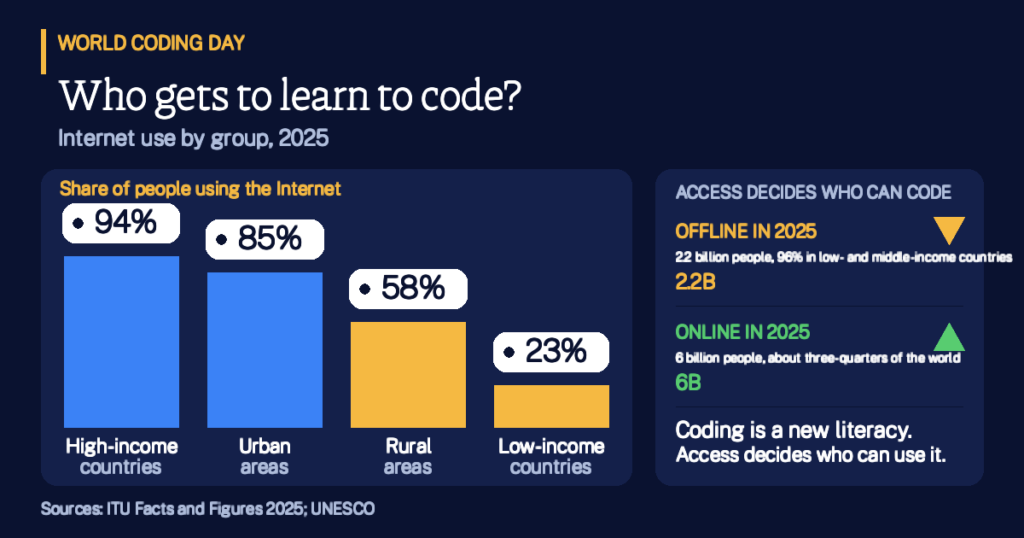
Coding needs a device and a connection, so the first numbers that matter are about access. The International Telecommunication Union (ITU), the UN agency for digital technologies, estimates that 6 billion people, about three-quarters of the world, are using the Internet in 2025, up from a revised 5.8 billion in 2024. That leaves 2.2 billion people offline, down from a revised 2.3 billion. The online population grew by more than 240 million in 2025, which is real progress, but the remaining gap is concentrated: ITU reports that 96 percent of those offline live in low- and middle-income countries.
The divides show up everywhere you look. ITU’s Facts and Figures 2025 reports that 94 percent of people in high-income countries use the Internet, against only 23 percent in low-income countries. In urban areas 85 percent are online, versus 58 percent in rural areas. Men are more likely to be online than women, 77 percent against 71 percent, while 82 percent of 15 to 24 year olds use the Internet, compared with 72 percent of everyone else.
- 6 billionpeople online in 2025, about three-quarters of the world
- 2.2 billionpeople still offline in 2025
- 23%Internet use in low-income countries, against 94% in high-income ones
- 96%of people offline live in low- and middle-income countries
Example 2: the missing hour. Imagine a village school with one shared computer and a weak connection. If 40 students share 20 hours of lab time a week, each gets 30 minutes. In a well-equipped school where every student has a device, the same 20 hours means 20 hours each. The numbers are round and illustrative, but the difference compounds: after 50 school weeks, one student has practiced about 25 hours and the other about 1,000.
Coding in the age of AI
UNESCO ties the day closely to artificial intelligence. Its page says learning to code remains a core competency and is integral to AI literacy, as set out in UNESCO’s two AI competency frameworks, one for teachers and one for students. The reasoning is practical. People who understand how instructions become behavior are better placed to question what an automated system does, to spot its limits and to build tools that serve their own communities. UNESCO also calls for rethinking how coding is taught, moving from rote instruction toward interdisciplinary learning in which coding is used to explore science, art, language and civic problems. The aim is not to turn every student into a professional engineer. It is to make sure no student is shut out of the conversation.
Who is left behind
UNESCO names the barriers directly. Students in high-income countries are far more likely to have access to computer science education, while learners in lower-income settings are often excluded. Teacher shortages, limited teacher development, and gaps in infrastructure and learning resources hold many schools back. Gender is a second fault line: UNESCO says girls are significantly less likely to acquire coding skills.
These gaps stack. A girl in a rural, low-income area can face the connectivity gap, the school-resource gap and the gender gap at once. Closing any one helps, but the day invites governments, schools and companies to look at all three together. That means training teachers, sharing open learning resources (UNESCO links its Recommendation on Open Educational Resources from the day’s page) and offering coding in ways that connect to local needs. UNESCO also runs a Youth Coding Initiative with the company CODEMAO.
Example 3: the teacher bottleneck. Suppose a district has 100 teachers and trains 25 of them in coding in the first year. If each trained teacher guides 30 students, 750 students gain a teacher who can help them, while 2,250 do not yet. Training all 100 would reach 3,000. The numbers are round and illustrative, but they show why teacher development matters, as UNESCO notes.
How the day is marked
Because the day is new, there is no fixed format. A school can run a beginner lesson, a community group can host an open workshop, or a family can try a first coding exercise together. A good question for any local school is how coding is taught and who gets access. Teachers are the bridge between a policy and a classroom, a theme explored in World Teachers Day.
Key Takeaways
- Coding is a new literacy. UNESCO describes it as a language of logic, creativity and problem-solving.
- The day is young. UNESCO Member States designated October 29, and it was first celebrated in 2024.
- Access comes first. In 2025, 6 billion people were online and 2.2 billion were not.
- The divides are wide. Internet use is 94 percent in high-income countries and 23 percent in low-income ones.
- Coding supports AI literacy. UNESCO links it to its AI competency frameworks for teachers and students.
- Girls and rural learners face stacked barriers. UNESCO says girls are significantly less likely to acquire coding skills.
- Teachers are the multiplier. Training and resources decide whether a school can offer coding at all.
How solid is this? Internet figures are ITU estimates from Facts and Figures 2025, and the 2024 numbers shown are revised estimates. UNESCO’s World Coding Day page gives no yearly themes or statistics, so none are stated here, and it does not name the session or resolution that designated the day. The three worked examples use round, made-up numbers to show an idea. See also the International Days hub and the International Days Calendar.
More in Education
- UNESCO, World Coding Day
- ITU press release, Facts and Figures 2025 (November 17, 2025)
- ITU, Measuring digital development: Facts and Figures 2025
- UNESCO, What you need to know about the AI competency frameworks for students and teachers
- UNESCO Director-General, message for World Coding Day
- UNESCO, UNESCO-CODEMAO Youth Coding Initiative