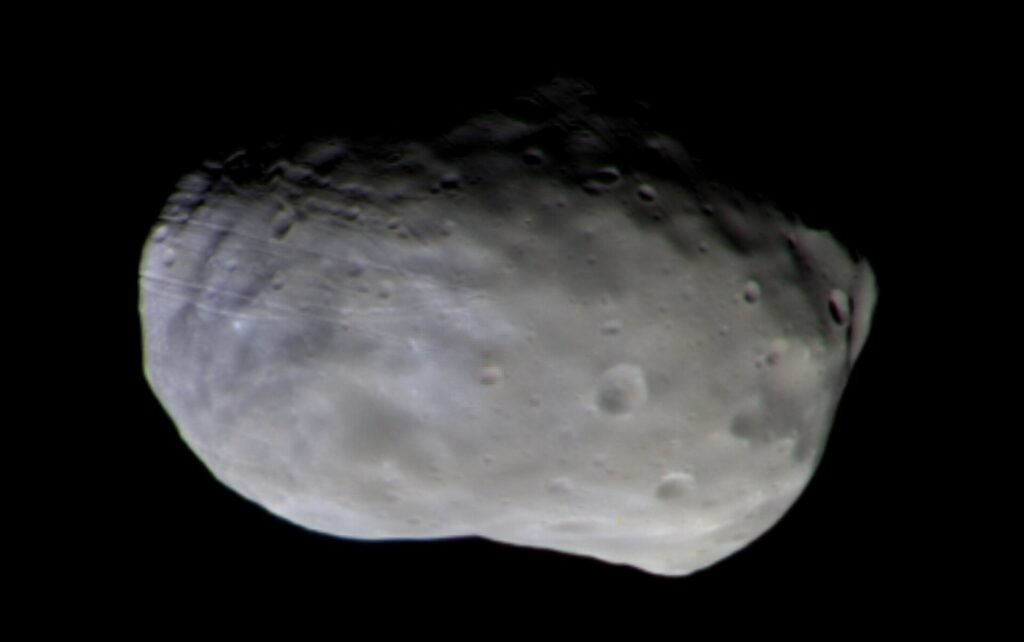
Japan’s space agency JAXA launched its Martian Moons eXploration mission, known as MMX, on October 20, 2026 Japan time, as MMX launches to Mars’s moons to study them and bring a sample of one of them back to Earth. ESA says the H3 rocket performed well, and NASA says it is contributing instruments, communications and funding. This article summarizes what NASA and ESA report about the mission, its goals and its timeline.
What happened at launch?
ESA reports that MMX launched on JAXA’s H3 rocket from the Tanegashima Space Center at 04:41 Japan time on October 20, 2026, which was the evening of October 19 in Europe. ESA describes the launch as successful. NASA’s earlier mission page had given the target as 3:41 p.m. EDT on October 19, which is the same moment. MMX is led by JAXA, with NASA, the French space agency CNES, the German space agency DLR and ESA as partners.
What is MMX trying to do?
NASA and ESA describe three firsts the mission aims for: to be the first spacecraft to orbit Phobos, the first to collect samples from its surface and the first to return to Earth from the Mars system. Scientists want to characterize Mars’s moons Phobos and Deimos and settle where they came from. NASA says one possibility is that they formed from debris of a massive impact on Mars, and another is that they are ancient asteroids captured by Mars’s gravity.
What does NASA contribute?
NASA lists these contributions:
- The MEGANE spectrograph, built by Johns Hopkins Applied Physics Laboratory, which measures neutrons and gamma rays from Phobos’s surface to find its chemical composition
- A Pneumatic Sampler, or P-Sampler, built by Honeybee Robotics, a Blue Origin company, which uses bursts of high-pressure nitrogen gas to collect surface material as a technology demonstration
- Deep Space Network communications and navigation support
- Funding for the U.S. scientists on the MMX science team
NASA also says it will obtain and curate about 15% of the returned sample at the Johnson Space Center Astromaterials Lab in Houston.
What is ESA’s role?
ESA provided the spacecraft’s deep space communication equipment. Its Estrack ground stations help send commands to the spacecraft and receive its data. European scientists appointed by ESA sit on the science team, planning observations, analyzing data and later studying the returned samples. ESA says MMX is a Science Programme Mission of Opportunity, meaning ESA joins a mission led by another agency.
What is the timeline?
NASA’s updated page gives these dates:
- Arrival at Mars: 2027
- Sample collection: no earlier than 2028
- Sample return to Earth: 2031
ESA says arrival is expected the following summer. The ESA page gives no return date, so we use NASA’s 2031 as the plan. By our own arithmetic, the gap from the October 2026 launch to a 2031 return is between four and five years, depending on the month. This calculation is ours, and the schedule remains a plan.
How to read the plan
Three kinds of statements appear in the sources. The launch is a past event that ESA confirms. The arrival and return dates are plans that could change. The three firsts are goals, not achievements, because the spacecraft has not yet reached Mars. The competing ideas about the origin of Phobos and Deimos are open questions, and neither NASA nor ESA says which is more likely.
Why study Mars’s moons?
Knowing whether Phobos and Deimos are captured asteroids or debris from an ancient impact would tell scientists something about how Mars and its neighborhood formed. A sample on Earth can be analyzed with far more precise laboratory tools than any spacecraft can carry. That is a general point about sample return and is not a quotation from NASA or ESA. It is also why the mission includes both remote instruments and a sampling device.
How does it relate to other missions?
MMX joins a busy period for small-body and planetary missions. Our article on ESA’s Hera mission covers a probe heading to a binary asteroid system, and our report on BepiColombo at Mercury covers another long cruise that is nearing its destination. Our summary of the Lucy mission describes a NASA spacecraft entering the Jupiter Trojan region, and the article on the Psyche mission covers a metal asteroid probe. They differ in targets, but all depend on years of careful travel.
Related reading: ESCAPADE Earth Flyby: NASA Twin Mars Spacecraft Swing Past Earth on November 7 and 9.
Glossary
- Phobos and Deimos: the two small moons of Mars
- Sample return: bringing material from another world back to Earth
- Spectrograph: an instrument that splits radiation into parts to identify materials
- Deep Space Network: NASA’s global system of large antennas for talking to distant spacecraft
- Astromaterials: rocks and dust from space kept for study
These definitions are general explanations and are not quoted from NASA or ESA.
What is not covered here?
The pages we used do not name every instrument on board, give the spacecraft’s mass or describe the landing method on Phobos. They also do not report any science results, since the spacecraft is only starting its trip. We have not added those details from memory.
Key facts at a glance
- Launch: October 20, 2026 Japan time, on JAXA’s H3 from Tanegashima
- Led by: JAXA, with NASA, CNES, DLR and ESA
- Arrival at Mars: 2027
- Sample collection: no earlier than 2028
- Return to Earth: 2031, with about 15% of the sample curated by NASA
Frequently asked questions
Did the launch succeed?
ESA says it did.
Will MMX land on Phobos?
The pages we used describe collecting a surface sample, but they do not give the method for reaching the surface.
When will samples reach Earth?
NASA’s plan is 2031.
More in Science
- NASA's Swift Observatory Ends Its Science Mission After Nearly 22 Years
- Teghaza 001: NASA-Funded Study Dates One of the Oldest Mars Meteorites at 4.1 Billion Years
- NASA's Atmospheric Waves Experiment (AWE) Completes Mission: 80 Million Images of Waves in the Upper Atmosphere
- ISS Science in 2025: NASA Reports More Than 750 Investigations and Six Highlights