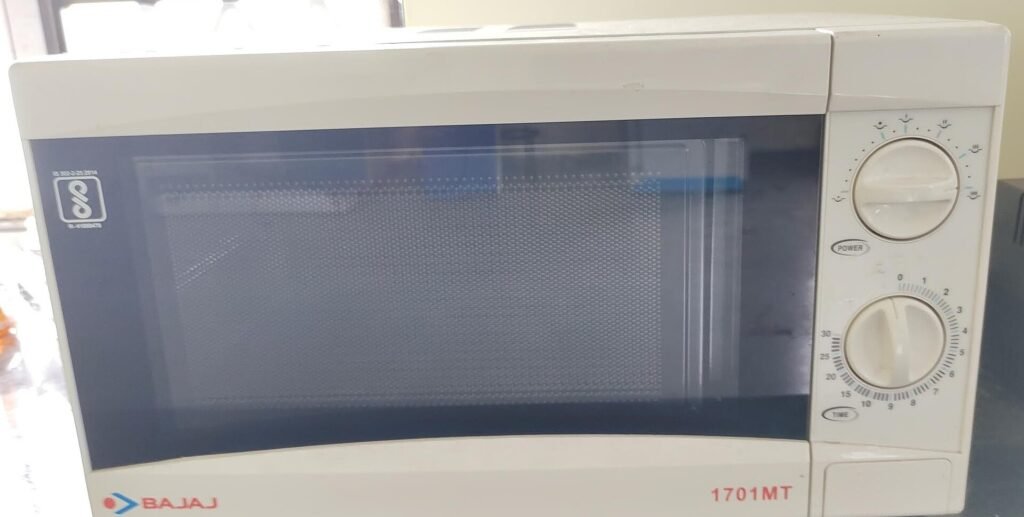
A microwave oven is a kitchen appliance that heats food with microwave radiation, which makes water molecules in the food rotate and produce heat. It grew out of World War II radar research, and the American engineer Percy Spencer is the person most often credited with turning a radar tube into a cooking device. Accounts of its early years differ in several details, which are noted below.
History of the microwave oven
The device that powers the oven is the magnetron, a high-powered vacuum tube that generates microwaves. It was used in World War II radar to detect enemy planes and submarines. In 1939 Raytheon received a contract from the M.I.T. Radiation Laboratory to develop radar, and Spencer was put in charge. He did not invent the magnetron, but he developed a system to mass-produce it, and a museum history says output rose from about 17 a day to about 2,600 a day after his simpler design.
According to the usual story, Spencer noticed that a candy bar in his pocket had melted while he stood near an operating magnetron. He then tested other objects in the path of the microwaves, and popcorn popped while an egg exploded. The Linda Hall Library notes that this rests on his own account, and an IEEE history dates the incident to 1946, while the Lemelson-MIT archive says only that it happened after the war.
Spencer’s first patent, number 2,495,429, was titled Method of Treating Foodstuffs and was filed on October 8, 1945. It described microwaves cooking food on a conveyor belt rather than in an enclosed oven, and it was awarded on January 24, 1950. A second patent, number 2,593,067, was filed on February 13, 1947 and shows a recognizable microwave oven. The IEEE history instead says Raytheon filed for a patent later in 1946, so the year of the first filing is reported inconsistently.
The first commercial model, the Radarange, was sold from 1947 to restaurants and commercial kitchens. Home models took far longer. Raytheon marketed a 220-volt wall unit to households in 1955 for $1,295, and it sold poorly. Raytheon bought the appliance maker Amana in 1965, and in 1967 Amana sold the first 110-volt countertop home model for $495.
Inventor and origins of the microwave oven
Spencer is the central figure, but the oven was a team effort. Marvin Bock, a Raytheon engineer, built the prototype, which was installed in a Boston restaurant for testing. Spencer was born on July 9, 1894, in Howland, Maine, and left grammar school as a boy to work in a weaving mill. He joined the U.S. Navy at 18 as a radio operator and taught himself calculus and physics from textbooks. He later held more than 100 patents, died on September 7, 1970, and was inducted into the National Inventors Hall of Fame in 1999.
Accounts of the early Radarange disagree on its size and price. The IEEE history describes a prototype of almost 2 meters in height weighing about 340 kilograms and selling for about $5,000. The Lemelson-MIT page describes a unit about 6 feet tall and about 750 pounds that cost $3,000, and the museum history gives a price range of $3,000 to $5,000 and says the oven needed water cooling.
How a microwave oven works
A microwave oven uses dielectric heating. High-frequency microwave radiation makes polar molecules in food, especially water, rotate back and forth, and that rotation produces thermal energy. Microwaves are electromagnetic radiation with a wavelength between 1 millimeter and 30 centimeters.
Spencer found that enclosing the energy in a metal box created a denser electromagnetic field, and food placed in the box heated very rapidly. The Linda Hall Library says he soon saw that enclosing the microwaves improved cooking. A magnetron creates the microwaves, and the metal cavity holds them around the food.
Types of microwave ovens
The earliest ovens were commercial units, refrigerator-sized machines with the cooking space of a modern oven. The 1955 Raytheon wall oven required a 220-volt supply, and the 1967 Amana countertop model ran on ordinary 110-volt current and made home use practical. The museum history says Tappan introduced an early home model in the 1950s, though it gives two different years.
Sharp developed Japan’s first microwave oven, the R-10, in 1961, and in 1962 it became the first company to mass-produce them. Raytheon, Amana and Sharp are therefore linked to three stages: the commercial unit, the household countertop oven and mass production in Japan.
Impact of the microwave oven
The oven changed how households cook and reheat. IEEE reports that U.S. annual sales rose from 40,000 to 1 million by 1975, and that in 1976 about 17 percent of Japanese families owned one, compared with 4 percent of American families. About 25 percent of U.S. households owned one by 1986, and by 1997 about 90 percent did, when the average price was about $200. A museum history gives much higher ownership figures for the 1970s, so adoption percentages from different sources should be treated with caution.
Regulation followed the spread. Tests at Walter Reed Hospital in 1968 found that microwaves leaked from ovens, and in 1970 the U.S. Bureau of Radiological Health set a legal maximum leakage of 1 milliwatt per square centimeter for new ovens and 5 milliwatts per square centimeter over an oven’s lifetime.
Uses of microwave ovens today
Microwave ovens are used in homes and kitchens to cook and reheat food, and the device descends from technology tested in World War II. The same magnetron principle is still found in radar, so one wartime component now serves both detection and cooking.
Early commercial users included restaurants and vending companies, which kept food refrigerated and heated it to order. Industries also used microwaves to dry potato chips, roast coffee beans and peanuts, defrost and precook foods, and temper meat, and for drying materials such as paper, ceramics and textiles.
More in Electrical Engineering
Key facts
- Percy Spencer led Raytheon's magnetron production for radar and is credited with the microwave oven.23
- Spencer filed a patent on October 8, 1945, and the patent was awarded on January 24, 1950.23
- The Radarange was first sold commercially in 1947.12
- Amana sold the first 110-volt countertop home model in 1967 for $495.14
- About 90 percent of U.S. households owned a microwave oven by 1997.1
Related concepts
In the news
Quick checkWho invented the microwave oven?Show answer
Percy Spencer of Raytheon is credited, after he noticed a candy bar melting near a magnetron. A Raytheon team including Marvin Bock built the prototype, and sources differ on patent and price details.
Sources
- IEEE Spectrum, A History of the Microwave Oven, https://spectrum.ieee.org/the-institute/ieee-history/a-history-of-the-microwave-oven
- Lemelson-MIT, Percy Spencer, https://lemelson.mit.edu/resources/percy-spencer
- Linda Hall Library, Scientist of the Day: Percy Spencer, https://www.lindahall.org/percy-spencer/
- Southwest Museum of Engineering, Communications and Computation, Microwave Oven, https://smecc.org/microwave_oven.htm
Editorially reviewed by Specialty Digest Editorial TeamLast reviewed November 4, 2026Researched and drafted with AI assistanceReport an issue