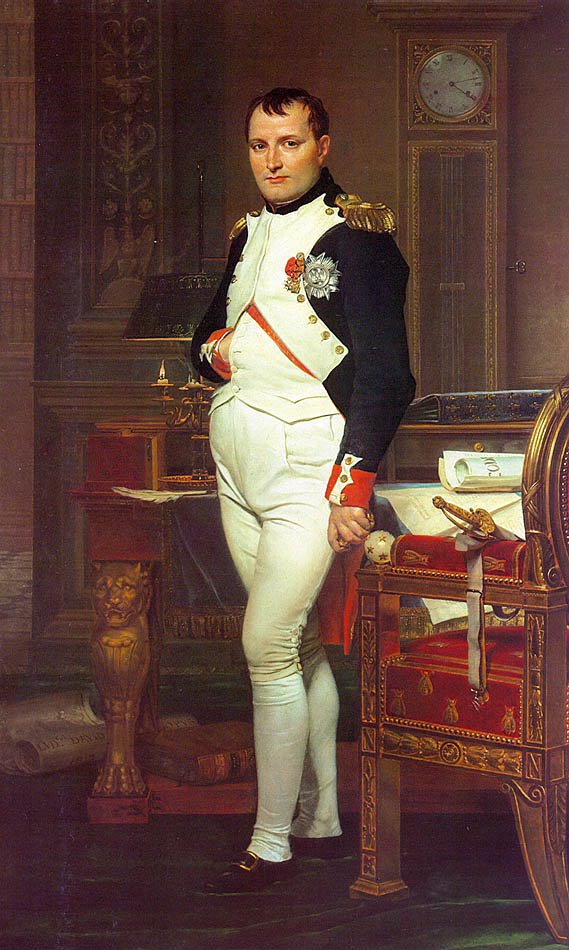
Napoleon Bonaparte (1769 to 1821) was a French military leader who seized power in 1799 and reigned as Emperor of the French from 1804 to 1814 and briefly again in 1815. He built the largest European empire since Charlemagne, issued a civil code that shaped legal systems far beyond France, and was finally defeated at Waterloo in 1815. He died in exile on the island of St. Helena on 5 May 1821.
Early life of Napoleon Bonaparte
Napoleon was born Napoleone di Buonaparte in Ajaccio, Corsica, on 15 August 1769, into a family of minor Corsican nobility. France had acquired Corsica from Genoa only the year before. His father, Carlo, was a lawyer who accepted French rule, and the family received new titles and honors in return.
In 1779 Napoleon entered the Royal Military School at Brienne, where his accent and fierce Corsican patriotism set him apart. He excelled at mathematics and graduated from the military academy in Paris in 1786 as an artillery lieutenant. He supported the French Revolution when it began in 1789, and in 1793 his family fled Corsica for France after clashing with supporters of Corsican independence.
Career and major work of Napoleon Bonaparte
At Toulon in December 1793 Napoleon’s artillery was central to the French victory, and he was promoted to brigadier general at the age of 24. In October 1795 he defended Paris against a royalist uprising and fired grapeshot into the crowd. He then took command of the French army in Italy and defeated Austrian forces in a series of battles, which led to the Treaty of Campo Formio in October 1797.
In 1798 he led an expedition to Egypt, where he won the Battle of the Pyramids but failed to take Acre, and he returned to France in 1799. The expedition produced the discovery of the Rosetta Stone. On 9 and 10 November 1799 he overthrew the government in a bloodless coup, known as the Coup of 18 Brumaire, and became First Consul.
He proclaimed the French Empire on 18 May 1804 and was crowned on 2 December that year in Notre-Dame de Paris, where he placed the crown on his own head. The Grande Armee, organized in semi-independent corps, defeated the Austrian and Russian armies at Austerlitz on 2 December 1805. By the Treaties of Tilsit in July 1807 his authority covered most of Western and Central Europe.
As First Consul he crossed the Alps and defeated the Austrians at Marengo on 14 June 1800, and in 1802 he secured peace with Britain in the Treaty of Amiens. A plebiscite then confirmed him as First Consul for life. Britain declared war on France again in May 1803, which opened the period known as the Napoleonic Wars.
His family life was tied to the question of succession. He had married Josephine de Beauharnais, a widow, on 9 March 1796, but divorced her in January 1810 because she had not produced an heir. In April 1810 he married the Austrian archduchess Marie Louise, and their son, Napoleon II, was born on 20 March 1811 and styled King of Rome. In the Jena campaign of October 1806 he had crushed the Prussian army at Jena and Auerstedt and entered Berlin within days, and he installed his brothers on the thrones of Naples, Holland and Westphalia, and later Spain.
Ideas and contributions of Napoleon Bonaparte
The most lasting of his reforms was the Napoleonic Code, a set of civil laws adopted across much of continental Europe that influenced the legal systems of many modern states. It remains a central example of codified civil law. As First Consul he also negotiated the Concordat of 1801, which reconciled France with the Catholic Church, and made the Louisiana Purchase, which doubled the size of the United States.
Militarily, he used conscription and made the corps the largest unit of an army, and he developed tactics that officers still study. According to one count, he fought 60 battles and lost only seven. Military writers often rank him alongside Alexander the Great and Julius Caesar.
Downfall and death of Napoleon Bonaparte
The Peninsular War in Spain and Portugal, which began in 1807 and 1808, tied down about 200,000 French soldiers. On 24 June 1812 Napoleon invaded Russia with more than 615,000 French and allied troops. He entered Moscow after the Battle of Borodino, but the Russians burned the city and the army had to retreat in the winter. By December 1812 the French had lost about half a million men.
After defeat at Leipzig on 16 to 19 October 1813, he abdicated on 11 April 1814 and was exiled to Elba. He returned to France on 1 March 1815, beginning the Hundred Days. At Waterloo on 18 June 1815 he commanded about 72,000 men and 246 guns against an Anglo-Allied army of 68,000 men and 156 guns under the Duke of Wellington, and the Prussian army arrived during the afternoon. The National Army Museum describes the battle as the end of French attempts to dominate Europe. He abdicated again four days later and was sent to St. Helena, where he died in 1821 at the age of 51.
Legacy of Napoleon Bonaparte
Napoleon is remembered as both a reformer and an autocrat. He ended the revolutionary period in France and left a legal code and an administrative model that spread widely. He also left a continent changed by almost two decades of war, and the Waterloo campaign closed a conflict that had lasted 23 years.
Controversies and criticism
As First Consul he sent an expedition to reclaim Haiti and restore slavery there. The force failed, and Haiti declared its independence in 1804. Critics also point to the destructive cost of his wars, to his appointment of relatives, including his brothers, to rule conquered kingdoms, and to the grapeshot fired into a crowd in Paris in 1795. Historians remain divided on whether to treat him mainly as a defender of revolutionary gains or as a ruler whose ambitions plunged Europe into repeated war.
More in History
Key facts
Related concepts
In the news
Quick checkWhat was the Napoleonic Code?Show answer
A set of civil laws he introduced during the Consulate that was adopted across much of continental Europe and influenced the legal systems of many modern states.
Sources
- World History Encyclopedia, Napoleon Bonaparte, https://www.worldhistory.org/Napoleon_Bonaparte/
- National Army Museum, Battle of Waterloo, https://www.nam.ac.uk/explore/battle-waterloo
Editorially reviewed by Specialty Digest Editorial TeamLast reviewed November 4, 2026Researched and drafted with AI assistanceReport an issue