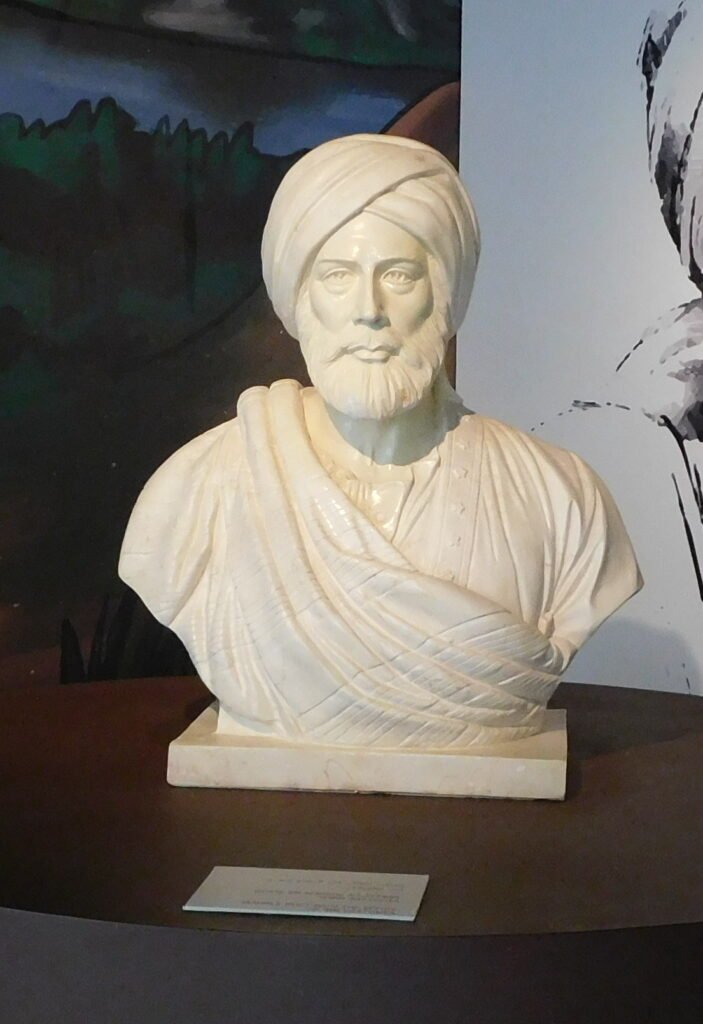
Ibn Battuta (1304 to about 1368) was a Moroccan scholar and judge who traveled for nearly 30 years across Africa, Asia and parts of Europe, covering roughly 75,000 miles (120,000 km). His travel book, the Rihla, is one of the most important eyewitness accounts of the 14th-century world.
Early life of Ibn Battuta
Ibn Battuta was born on 25 February 1304 in the old city of Tangier in Morocco. His full name was Shams al-Din Abu Abdallah Muhammad ibn Abdallah ibn Muhammad ibn Battuta, and he seems to have gone by Shams al-Din during his lifetime. He came from an educated family of qadis, or Islamic judges, and he memorized the Quran. Nearly everything known about his family comes from his own book.
In June 1325, at about age 21, he left home to make the pilgrimage to Mecca. By his own account he set out alone, driven by a long-held wish to visit the holy sites, and he felt the pain of leaving his parents. He had no plan to go much farther than Mecca.
Career and travels
He crossed North Africa to Tunis and Alexandria, often joining caravans for protection, then went to Cairo and on through Palestine and Syria. In Damascus he admired the city’s beauty and the endowments that paid for everything from education to broken dishes. He reached Mecca in October 1326.
After the pilgrimage he kept going, as a scholar, a traveler and, increasingly, a person who made a living from the favor of rulers. Over the next years he visited Iraq and Persia, sailed down the Red Sea toward East Africa and the Arabian Sea, and crossed Anatolia. He also escorted a princess to Constantinople, where he saw the Hagia Sophia. He then crossed Central Asia, and by about 1334 he reached India.
The Sultan of Delhi appointed him one of the city’s chief judges, a post he held until about 1341. He later left India and served as a judge in the Maldives, visited Sri Lanka, and continued to Southeast Asia and China. He returned west by sea and by land. In 1348 he passed through Syria at the height of the Black Death, and his description of the plague is recognized as one of the first detailed eyewitness records of it. He reached Morocco late in 1348 or in 1349, to find that his parents had died of the plague.
He did not stay. He visited al-Andalus and then, in about 1350 and 1351, set out across the Sahara to the Mali Empire, reaching Timbuktu and Gao on the Niger. He was back in Fez by 1352 or 1354, depending on the source.
The Rihla and what it records
The Sultan of Morocco, Abu Inan, ordered that Ibn Battuta dictate an account of his travels, and the sultan hired a young writer, Ibn Juzayy, to put it into the form of a travel book. Ibn Battuta kept no diary, so the book was composed from memory in the mid 1350s. The Arabic title is Tuhfat al-anzar, usually rendered as A Gift to Those Who Contemplate the Wonders of Cities and the Marvels of Traveling. Rihla, meaning travel, is the name of the literary genre and not the book’s real title, though it is the name by which the book is known.
The text covers perhaps 40 modern countries across three continents. It describes cities, rulers, scholars and Sufi holy men, and it records everyday facts that official chronicles skip, such as the paved streets of Damascus, the generosity of religious endowments, ships with many sails, and the ways people dressed. For historians of Mali, India, the Maldives and the Swahili coast, it is a major source.
Ibn Battuta wrote as a legal scholar and a believing Muslim, and he often judged local customs by his own standards. He complained, for example, about how women dressed in the Maldives and said he could not persuade them to cover themselves while he served as judge. He also married several times, had children in different places, and, like many people of his time, bought and sold slaves. Such details make the book a source about him as well as about the places he saw.
Doubts and criticism
Scholars generally accept that the Rihla is reliable in outline, but they have raised questions about details. One problem is memory. Critics doubt that anyone could recall 30 years of observations so clearly, and some think Ibn Juzayy or Ibn Battuta added to the account. Passages describing Damascus, Mecca and Medina match, almost word for word, passages written more than a century earlier by the Andalusian poet and traveler Ibn Jubayr. It seems that Ibn Juzayy used earlier travel writing to fill gaps.
Another question is whether Ibn Battuta visited every place he described. Some scholars have questioned whether he could have visited every place he cites. Defenders point out that medieval readers did not value originality as modern ones do, and that the borrowing does not disprove the travels. The prevailing scholarly view is that he did travel very widely but that the book mixes personal observation with borrowed and secondhand material.
Legacy of Ibn Battuta
Ibn Battuta disappears from the record soon after the book was finished. He was probably given a government post in Morocco and died in 1368 or 1369, most likely in Fez. A tomb in the old city of Tangier is traditionally identified as his burial place.
His book was little known outside the Arabic-reading world until the 19th century, when German and English scholars brought it to wider attention. Since then it has been translated into many languages and used by historians of the Islamic world, South Asia and Africa. He is now compared with Marco Polo and with Zheng He, and he is sometimes described as the most widely traveled person of his time. His museum in Tangier, a bust and many streets and schools carry his name, and his work remains a favorite source for readers curious about how the medieval world was connected.
Key facts
- Ibn Battuta was born on 25 February 1304 in Tangier, Morocco.1
- He left Tangier in June 1325 for the pilgrimage to Mecca and traveled for nearly 30 years.1
- He covered about 75,000 miles (120,000 km) and visited the equivalent of 40 to 44 modern countries.2
- He dictated his travel book to the scholar Ibn Juzayy in Fez in the mid 1350s.2
- Scholars note that some passages were borrowed from earlier travel writers such as Ibn Jubayr.1
Related concepts
Quick checkWhat is the Rihla of Ibn Battuta?Show answer
It is the account of his travels, dictated from memory to the scholar Ibn Juzayy in Fez in the mid 1350s. The word rihla names a travel-writing genre, and the book has a longer Arabic title.
Sources
- World History Encyclopedia, Ibn Battuta, https://www.worldhistory.org/Ibn_Battuta/
- ORIAS, University of California Berkeley, The Travels of Ibn Battuta, https://orias.berkeley.edu/resources-teachers/travels-ibn-battuta
Editorially reviewed by Specialty Digest Editorial TeamLast reviewed November 4, 2026Researched and drafted with AI assistanceReport an issue