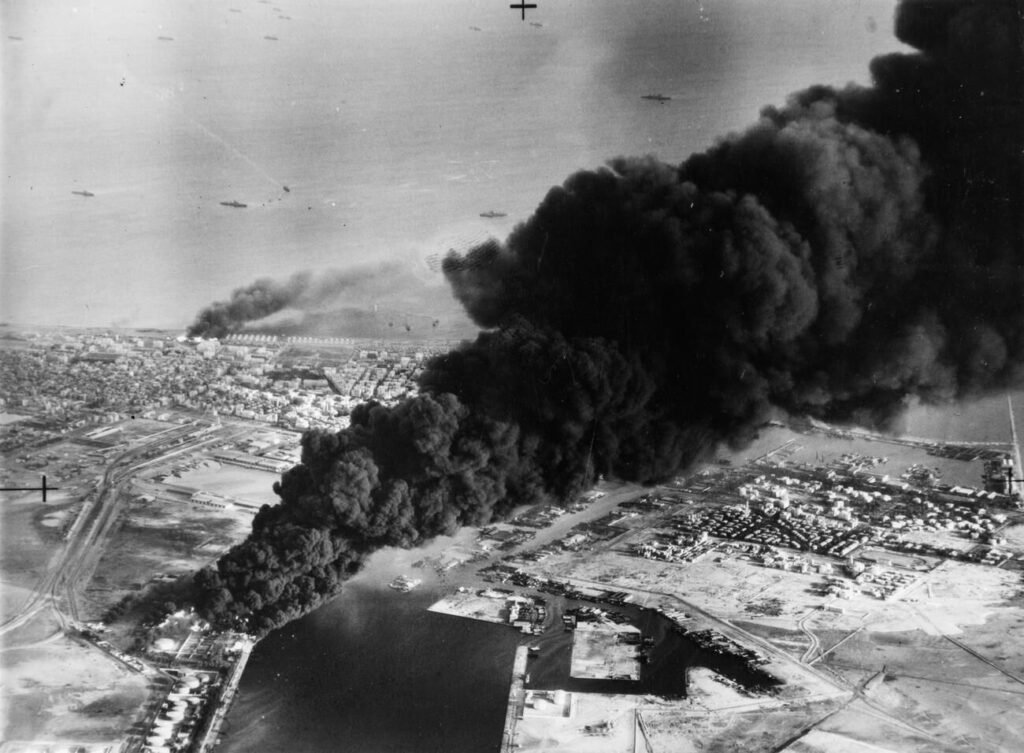
The Suez Crisis of 1956 was an international conflict that began when Egypt nationalized the Suez Canal Company on 26 July 1956 and ended after Britain, France and Israel invaded Egyptian territory in October and November. Pressure from the United States and the Soviet Union and a ceasefire arranged through the United Nations forced the invaders to withdraw, and the episode became a turning point for European influence in the Middle East.
Background to the Suez Crisis
The Suez Canal, opened in 1869, links the Mediterranean Sea with the Red Sea and was owned and run by a joint British and French company. Egyptian President Gamal Abdel Nasser opposed the continuing political influence of Britain and France in the region, and the two governments distrusted him. In his view, European efforts to keep control of the canal were a form of colonialism that had to end.
Tension rose in 1956 on several fronts. On 19 July the United States withdrew its offer of financial aid for the Aswan Dam on the Nile. A week later Nasser announced that the canal company would be nationalized and that canal fees would pay for the dam. The Office of the Historian of the US State Department records that Nasser offered full compensation to the shareholders, but Britain and France were outraged.
Relations between Egypt and Israel had also worsened since 1955. According to the United Nations, Palestinian raiders based in Gaza attacked Israel with Egyptian support, Israel carried out reprisals, and Egypt restricted Israeli shipping through the canal and the Strait of Tiran. Egypt and Israel were both buying large amounts of weapons from East and West.
Course of events
The administration of US President Dwight D. Eisenhower tried to settle the dispute by diplomacy. On 9 September Secretary of State John Foster Dulles proposed a Suez Canal Users’ Association of 18 maritime nations, but none of the main parties fully accepted it. Britain and France took the issue to the UN Security Council in late September. On 13 October the Council unanimously adopted resolution 118, which set out six principles for a settlement, including free transit and respect for Egyptian sovereignty.
Meanwhile, Britain and France held secret talks with Israel, which saw Nasser as a threat. They agreed on a joint plan to invade Egypt and remove him. On 29 October 1956 Israeli forces attacked across the Sinai Peninsula and advanced to within about 10 miles of the canal. On 30 October Britain and France issued an ultimatum telling both sides to stop fighting and withdraw from the canal, and Egypt rejected it. Britain and France then bombed Egyptian targets from 31 October and landed troops at Port Said, claiming they were protecting the canal from the two combatants.
The Security Council could not act, because Britain and France vetoed a US draft calling on Israel to withdraw. The issue moved to the General Assembly under the “Uniting for Peace” procedure. On 2 November the Assembly called for an immediate ceasefire and the withdrawal of all forces by a vote of 64 to 5, with 6 abstentions. Two days later it asked the Secretary-General, Dag Hammarskjöld, to plan an emergency international force, an idea developed with the Canadian diplomat Lester Pearson.
The Eisenhower administration, worried about being linked to European colonialism and about possible Soviet involvement, pressed Britain and France to accept a ceasefire. This was happening in the same week as the Soviet intervention in Hungary, which the United States was condemning. Britain and France ordered a ceasefire at midnight GMT on 6 November, and the ceasefire took effect that night, on 7 and 8 November, according to the United Nations.
Aftermath of the Suez Crisis
The first units of the new United Nations Emergency Force (UNEF) flew to Egypt on 15 and 16 November 1956, and the force reached its target strength of about 6,000 men in February 1957. British and French troops completed their withdrawal from Port Said on 22 December 1956, and UNEF took over the area. Israel withdrew in stages, and the United Nations reported full Israeli withdrawal from Egyptian territory, including Sharm el Sheikh, on 8 March 1957.
The political damage to the invaders was serious. Public US criticism of its two allies temporarily soured relations with London and Paris. It also contributed to the resignation of British Prime Minister Anthony Eden in January 1957. The Office of the Historian notes that relations between the United States and the United Kingdom had recovered by March 1957 under Eden’s successor, Harold Macmillan.
Significance and legacy of the Suez Crisis
For the United Nations the crisis was a landmark. The UN itself describes UNEF as its first peacekeeping force, a new type of operation that placed neutral soldiers between combatants with the consent of the host country. The idea owed a great deal to Hammarskjöld and Pearson, and it set a pattern for later peacekeeping missions. UNEF remained in place until Egypt asked for its withdrawal, which took place from 18 May 1967.
For Britain and France the episode exposed the limits of their power in the Cold War era. The episode showed that they could not act against the wishes of the United States, and American officials worried afterward about the future of European political and military power in the region. Egypt kept control of the canal, which Nasser had nationalized, and the invading governments did not achieve their aim of removing him.
The crisis also changed American policy. The Office of the Historian says that US worries about the future of European power in the Middle East led to the Eisenhower Doctrine of 1957, which gave the president wider authority to aid countries in the region. The crisis therefore shifted the balance of influence in the Middle East from the old European powers to the United States and the Soviet Union.
Historians still debate details of the secret planning by Britain, France and Israel. The sources opened for this entry do not give reliable casualty figures, so none are stated here. What is clear is that the crisis ended with the three invading states withdrawing and with Egypt in control of the Suez Canal.
More in International Relations
Key facts
- Egyptian President Gamal Abdel Nasser announced the nationalization of the Suez Canal Company on 26 July 1956.12
- Israel attacked across Sinai on 29 October 1956, and Britain and France landed troops near Port Said a few days later.12
- The UN General Assembly called for a ceasefire on 2 November 1956 by a vote of 64 to 5, and the ceasefire took effect on 7 and 8 November.2
- Anglo-French forces completed their withdrawal on 22 December 1956, and Israeli forces left Sinai and Sharm el Sheikh by 8 March 1957.2
- The United Nations Emergency Force, its first peacekeeping force, was withdrawn from 18 May 1967 at Egypt's request.2
Related concepts
Quick checkWhat started the Suez Crisis?Show answer
Egypt's nationalization of the British and French owned Suez Canal Company on 26 July 1956 started it. Britain, France and Israel then planned and carried out an invasion in October and November.
Sources
- Office of the Historian, US Department of State, The Suez Crisis, 1956, https://history.state.gov/milestones/1953-1960/suez
- United Nations Peacekeeping, First United Nations Emergency Force (UNEF I), Background (Full text), https://peacekeeping.un.org/sites/default/files/past/unef1backgr2.html
Editorially reviewed by Specialty Digest Editorial TeamLast reviewed November 4, 2026Researched and drafted with AI assistanceReport an issue