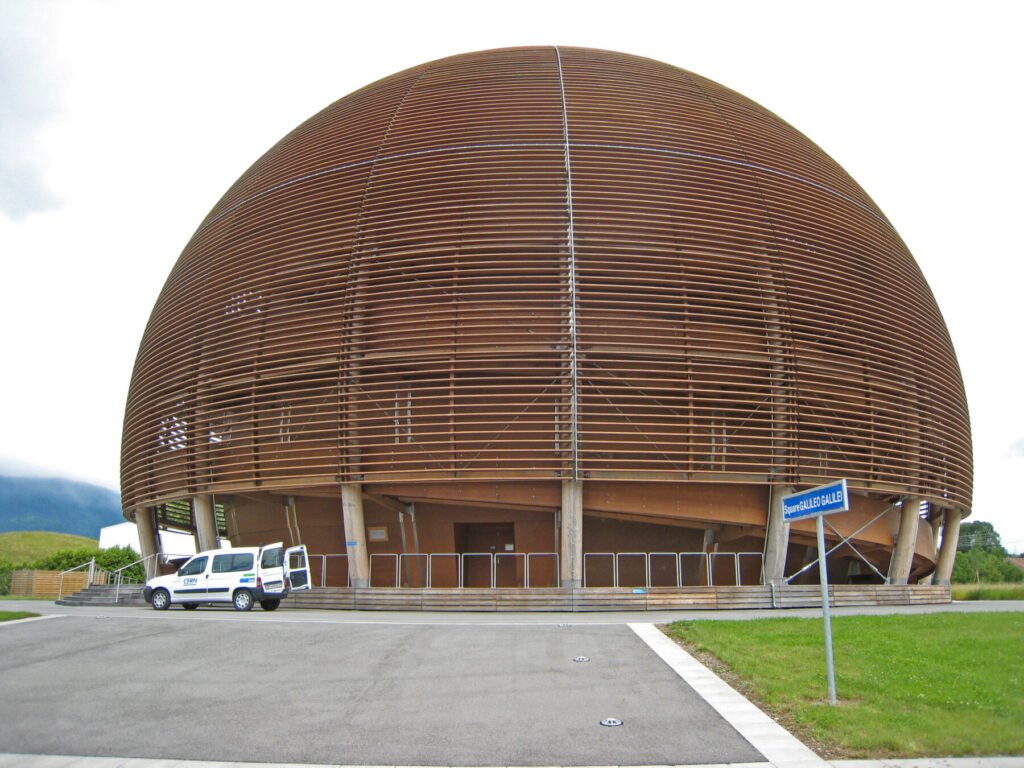
CERN, the European Organization for Nuclear Research, is an intergovernmental laboratory on the Franco-Swiss border near Geneva that studies the fundamental particles of matter. Founded in 1954, it has 25 member states and operates the Large Hadron Collider, the world’s largest and most powerful particle accelerator.
History of CERN
CERN’s origins go back to the 1940s, when a small group of scientists in Europe and North America saw that Europe needed a world-class physics laboratory of its own. They wanted to stop the brain drain to America that had begun during the Second World War, and to give postwar Europe a project that would bring countries together.
At an intergovernmental meeting of UNESCO in Paris in December 1951, delegates adopted the first resolution on a European Council for Nuclear Research, in French Conseil Européen pour la Recherche Nucléaire. Two months later an agreement created a provisional council and gave it 18 months to produce a formal convention. The acronym CERN dates from that provisional body.
The CERN Council met in Paris from 29 June to 1 July 1953, and 12 states signed the convention that established the organization, subject to ratification. The laboratory was founded in 1954, and the first foundation stone was laid on the site in 1955.
The convention states that the organization has no concern with work for military requirements and that its experimental and theoretical results are to be published or otherwise made generally available. That commitment to peaceful, open research still shapes how CERN describes itself.
Structure and membership of CERN
CERN is run by its member states, which also provide its primary funding. As of 2026 it has 25 member states, and 11 associate member states and other partners around the world take part in its work.
Associate membership was created in 2010 under a policy of geographical enlargement. It lets a country take part in CERN’s scientific and technical programs and engage with the organization at an institutional level. Since 2012, 14 countries have become associate members, and three of them later became full members: Serbia in 2019, Estonia in 2024 and Slovenia in 2025. The associate members listed in 2026 are Brazil, Chile, Croatia, Cyprus, India, Ireland, Latvia, Lithuania, Pakistan, Turkiye and Ukraine.
About 2,500 people work for CERN itself, in roles that range from physicists and computer scientists to cooks. The wider research community that uses its facilities is much larger, with more than 12,200 scientists of 110 nationalities from institutes in more than 70 countries.
Governance and funding of CERN
The CERN Council is the highest authority of the organization. It approves programs of activity, adopts budgets and reviews expenditure. Each member state sends two delegates, one representing its government administration and one representing national scientific interests, and each state has a single vote. Most decisions need a simple majority, though the Council aims for consensus as close to unanimity as it can reach.
Two committees assist the Council. The Scientific Policy Committee judges the scientific merit of proposed activities, and its members are scientists appointed for their eminence without reference to nationality. The Finance Committee, made up of representatives of national administrations, handles member state contributions, the budget and spending.
The Director-General, appointed by the Council usually for five years, manages the laboratory through a directorate and a structure of departments. Member states supply the core funding, while associate member states contribute financially and take part in the scientific programs. Companies in member states can compete for CERN procurement contracts, which links the laboratory’s needs to industry in those countries.
What CERN does
CERN builds and operates particle accelerators and detectors. Accelerators boost beams of particles to high energies before the beams collide with each other or with fixed targets, and detectors record what happens. The results give clues about how particles interact and about the basic laws of nature.
The Large Hadron Collider started up on 10 September 2008. It is a 27-kilometer ring of superconducting magnets in a tunnel about 100 meters underground, and it pushes protons or heavy ions to close to the speed of light. The magnets are cooled to minus 271.3 degrees Celsius with liquid helium, and 1,232 dipole magnets, each 15 meters long, bend the beams around the ring. The beams collide at four points, where the ATLAS, CMS, ALICE and LHCb detectors sit.
The best-known result so far is the Higgs boson. The Higgs field was proposed in 1964 as a field that fills the universe and gives mass to elementary particles. The boson is a wave in that field, and it shows up in only about one in a billion LHC collisions. On 4 July 2012 the ATLAS and CMS collaborations announced a new particle with no electric charge that decayed in the ways theory predicts for the Higgs boson.
The Royal Swedish Academy of Sciences awarded the 2013 Nobel Prize in Physics to François Englert and Peter Higgs for the theory of how particles acquire mass, noting that the ATLAS and CMS experiments at CERN had confirmed it. CERN also points to its early discovery of neutral currents as a milestone in particle physics.
The World Wide Web and computing at CERN
CERN is one of the most demanding computing environments in research. The World Wide Web was conceived and developed there to meet the need for automated information sharing between scientists in universities and institutes around the world.
Tim Berners-Lee first worked at CERN as a consultant in 1980, writing a program that linked pieces of information. After returning, he wrote his proposal for the Web in March 1989 and a second one in May 1990. By the end of 1990 the first Web server and browser were running at CERN.
For physics data, CERN relies on the Worldwide LHC Computing Grid, a distributed computing infrastructure arranged in tiers. It gives thousands of physicists near real-time access to LHC data, with the CERN data center as the first point of contact between the experiments and the grid.
Impact and legacy of CERN
CERN has become a model of large-scale scientific cooperation. Its findings test the Standard Model, the framework that describes the known fundamental particles and forces, and its technology has reached well beyond physics, most visibly through the Web.
The scale of its instruments means that no single country could easily build them alone, which is the reason its founders gave for creating a shared European laboratory. That logic has since drawn in countries beyond Europe through associate membership, so the organization now describes itself as a global hub for scientific collaboration across borders.
More in Physics
Key facts
- CERN was founded in 1954, and 12 states signed its convention in 1953 in Paris.1
- CERN has 25 member states and 11 associate member states as of 2026.4
- The Large Hadron Collider first started up on 10 September 2008 and is a 27-kilometer ring about 100 meters underground.5
- The ATLAS and CMS collaborations announced the discovery of a Higgs boson candidate at CERN on 4 July 2012.6
- The 2013 Nobel Prize in Physics went to François Englert and Peter Higgs for the theory of how particles acquire mass.10
- Tim Berners-Lee wrote his World Wide Web proposal at CERN in March 1989.11
Related concepts
In the news
Quick checkWhat does the CERN convention say about military work?Show answer
It says CERN has no concern with work for military requirements, and that its experimental and theoretical results are to be published or otherwise made generally available.
Sources
- CERN. Our History. Undated (accessed 4 November 2026)
- CERN. About CERN. Undated (accessed 4 November 2026)
- CERN. Our Governance. Structure as of 2026 (accessed 4 November 2026)
- CERN. Our Stakeholders. 2026 (accessed 4 November 2026)
- CERN. The Large Hadron Collider. Undated (accessed 4 November 2026)
- CERN. The Higgs boson. Undated (accessed 4 November 2026)
- CERN. Computing. Undated (accessed 4 November 2026)
- CERN. Who we are. Undated (accessed 4 November 2026)
- CERN. Our people. Undated (accessed 4 November 2026)
- Nobel Prize Outreach. The Nobel Prize in Physics 2013, Press release. 2013 (accessed 4 November 2026)
- University of Oregon Institute for Fundamental Science. CERN70: Where the Web was born. 20 August 2024 (accessed 4 November 2026)
- World Wide Web Consortium. A Little History of the World Wide Web. Undated (accessed 4 November 2026)
Editorially reviewed by Specialty Digest Editorial TeamLast reviewed November 4, 2026Researched and drafted with AI assistanceReport an issue