Most people know that the United Nations works in six languages. Fewer know that one of them had to wait until 1973 for a full seat at the table. Arabic Language Day, observed every year on December 18, marks that moment. It is also a yearly invitation to look at a language that is used daily by hundreds of millions of people, written in a script admired for its beauty, and tied to centuries of learning. In the same spirit as World Turkic Language Family Day, it asks a simple question: what do we lose when a language goes unheard, and what do we gain when it is welcomed?
Why December 18
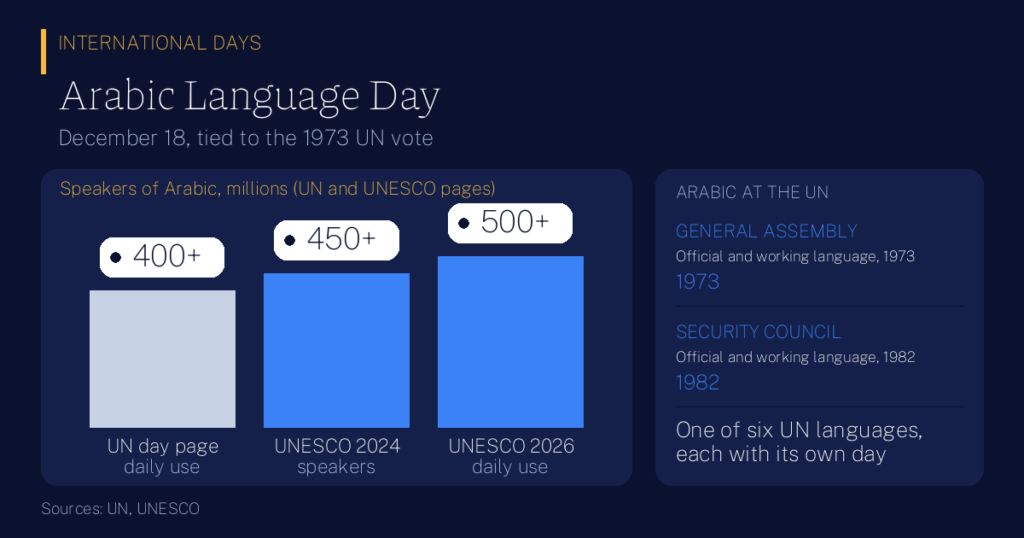
The date is not random. According to the United Nations, its Department of Global Communications, formerly the Department of Public Information, adopted a decision on the eve of International Mother Language Day to celebrate each of the six official languages of the UN. For Arabic, the chosen date was December 18, because on that day in 1973 the General Assembly adopted resolution 3190 (XXVIII), which included Arabic among the official and working languages of the Assembly and its Main Committees.
UNESCO, the UN agency for education, science and culture, says the day has been celebrated every year on December 18 since 2012. The UN page does not give the year of its own decision, so this article does not guess one. What both organizations agree on is the anchor: the 1973 vote.
How Arabic earned its place at the UN
Arabic was not given every role at once. The UN Library’s records show a staged path. Resolution 3190 of December 18, 1973 made Arabic an official and working language of the General Assembly and its Main Committees. On the same day, resolution 3189 gave Chinese the status of a working language of the Assembly. Later steps extended Arabic to other bodies, one by one.
Example 1: the translation chain. Imagine a 5,000-word report that must appear in the five other official languages as well as Arabic. That is 25,000 translated words before anyone has read a line. The numbers are round and illustrative, but they show what language rights cost in practice, and why they matter: a delegate who can work in a familiar language can argue, vote and question with full confidence.
One of six languages, each with its own day
Arabic shares the stage with Chinese, English, French, Russian and Spanish. The six official languages each have a day on the UN calendar, meant to celebrate multilingualism and cultural diversity. English and Spanish share April 23, while Arabic’s day falls late in the year, close to the 1973 anniversary.
The numbers, and why they differ
How many people use Arabic? The honest answer is that the UN family gives more than one figure. The UN observance page and UNESCO’s day page say it is used daily by more than 400 million people. UNESCO’s 2024 event article says it is spoken by over 450 million. UNESCO’s 2026 page says used daily by more than 500 million. Its Arabic programme page counts 450 million native speakers. These figures use different definitions and years, and none is a precise census.
Example 2: the gap. Suppose one estimate says 400 million and another says 500 million. The difference is 100 million people, or one quarter of the lower figure. The numbers are illustrative, but the lesson is real: when counting a language that spans many countries and dialects, it matters whether you count native speakers, daily users or everyone who can read it.
- Nearly 25countries where Arabic holds official status, per UNESCO (2024)
- Over 50languages that draw vocabulary from Arabic, per UNESCO
- 1,500+years of written tradition, per UNESCO
- 6official languages of the United Nations
A language with a long memory
UNESCO says Arabic can be traced to the Arabian Peninsula well over a thousand years ago, and describes a written tradition stretching over 1,500 years. Inscriptions at Jabal Ikmah in AlUla, Saudi Arabia, help trace the early evolution of the script. Arabic calligraphy is inscribed on UNESCO’s Intangible Cultural Heritage list, a reminder that for many readers the letters are art as well as writing.
The language also carried knowledge across borders. UNESCO notes that it played a role in transmitting Greek and Roman sciences to Renaissance Europe, and that it is an important source of vocabulary for over 50 languages spoken today. Classical Arabic lives alongside many dialects used by millions of people, so a single word for “Arabic” covers a family of everyday speech and a shared written standard.
Technology, inclusion and how the day is marked
The yearly theme shows what the language community is thinking about. In 2024 it was Arabic and artificial intelligence, advancing innovation while preserving cultural heritage. In 2025 it was innovative pathways for a more inclusive linguistic future. The 2026 observance at UNESCO headquarters in Paris, on Friday, December 18, centers on cultural diversity and dialogue.
- 2024Arabic Language and AI: advancing innovation while preserving cultural heritage
- 2025Innovative Pathways for Arabic: policies and practices for a more inclusive linguistic future
- 2026Arabic language and cultural diversity: celebrating dialogue and mutual understanding
UNESCO also runs a programme for the language named for Prince Sultan bin Abdulaziz Al Saud. It was launched in 2016 through a partnership with the Sultan bin Abdulaziz Al Saud Foundation, reported at USD 5 million over five years, and UNESCO credits the Foundation with supporting the day.
Example 3: the interpreters’ booth. Picture a meeting with interpretation into all six languages, and say two interpreters staff each booth. That is 12 interpreters for one session. The numbers are made up and rounded, but they show the human effort behind a simple idea: everyone should be able to take part in their own language.
Ordinary people can join in. Read a poem in translation, learn the alphabet, visit a calligraphy exhibit, or ask which languages are spoken in your own community. The day celebrates Arabic, but its spirit is multilingualism for everyone.
Key Takeaways
- The date is a history lesson. December 18 marks the 1973 General Assembly resolution that made Arabic an official and working language.
- Recognition came in stages. The Assembly, its subsidiary organs, ECOSOC and the Security Council each acted at different times between 1973 and 1982.
- Six languages, six days. The UN gives each official language its own day to celebrate multilingualism.
- Counts vary by source. UN family pages give 400, 450 or 500 million, so read figures with their definitions.
- A deep written heritage. UNESCO cites 1,500 years of writing and listed calligraphy as intangible heritage.
- Language shapes participation. Interpretation and translation let people argue and decide in a language they know.
- Everyone can take part. Learn a word, read a translation or support language learning in your community.
How solid is this? The dates and resolution numbers come from UN records. Speaker figures are estimates that differ between UN and UNESCO pages, and “nearly 25 countries” is UNESCO’s approximate wording. The year of the UN department decision creating language days was not stated on the sources checked, so it is omitted. The three worked examples use round, made-up numbers. See also the International Days hub and the International Days Calendar.
More in Society
- United Nations. World Arabic Language Day.
- UN Dag Hammarskjold Library. What are the official languages of the United Nations? (updated January 2026).
- UNESCO. World Arabic Language Day.
- UNESCO. World Arabic Language Day 2026.
- UNESCO. World Arabic Language Day 2024.
- UNESCO. Prince Sultan Bin Abdulaziz Al Saud Programme for the Arabic Language.
- United Nations. Celebrate Multilingualism: UN Language Days.