Sexual violence in war is among the oldest and least discussed harms of armed conflict. For much of history it was treated as an unavoidable by-product of fighting. The United Nations now treats it as what it is: a crime, a tactic and a barrier to peace. The International Day for the Elimination of Sexual Violence in Conflict, observed every June 19, honors survivors, recognizes the people who work to help them and calls for an end to impunity. This article is factual by design and avoids graphic detail. Anyone who needs support can reach a local health service, a trusted humanitarian organization or a national helpline for confidential help.
Why June 19
The date is not random. It commemorates June 19, 2008, when the Security Council adopted resolution 1820. That resolution recognized sexual violence as a weapon and tactic of war. It noted that rape and other forms of sexual violence can constitute a war crime, a crime against humanity or a constitutive act with respect to genocide. It also stressed that such crimes should be excluded from amnesty provisions in peace processes, and it called on states to prosecute those responsible and to give victims equal protection and equal access to justice.
Seven years later, on June 19, 2015, the General Assembly adopted resolution A/RES/69/293 by consensus and proclaimed the day. Argentina led the drafting of the text. The choice of date ties the observance to the Security Council decision that changed how the world talks about wartime sexual violence: not as private tragedy or unavoidable collateral damage, but as a matter of international peace and security.
What the term means
The UN uses the phrase conflict-related sexual violence for rape and other forms of sexual violence linked to an armed conflict, whether committed against women, girls, men or boys. Resolution 1820 matters because it moved the issue out of the shadows of private suffering and into the work of the Security Council. Crimes of this kind can be used to terrorize communities, to force people from their homes or to punish and humiliate. When that happens, protecting civilians and building peace cannot succeed without addressing it.
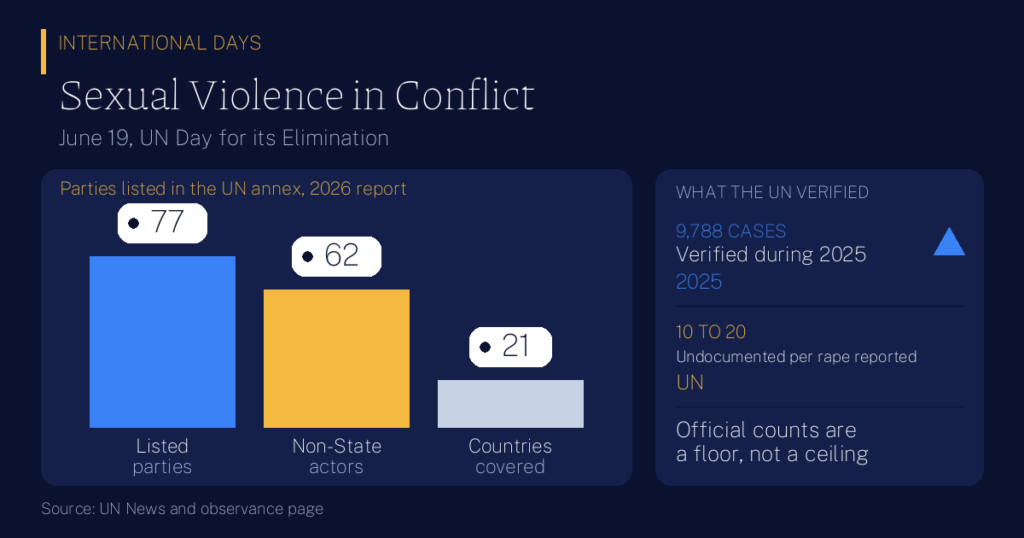
The scale of the problem is hard to measure. The UN observance page states that for each rape reported, 10 to 20 cases go undocumented. Fear, stigma, damaged health systems, insecurity and the risk of retaliation keep many survivors silent. That is why every official count is best read as a floor, not a ceiling.
Example 1: reading a count. Suppose a district records 1,000 reported rapes in a year. If 10 to 20 cases go undocumented for each one reported, the true number could be many times larger than the record. These numbers are round and illustrative, but they show why the UN urges caution whenever a figure is used to claim that violence is rising or falling.
The numbers behind the day
The most recent annual report of the Secretary-General, issued in 2026 as S/2026/321, covers 21 conflict-affected countries. The United Nations verified 9,788 cases of conflict-related sexual violence during 2025, which UN News describes as more than double the previous year’s figure. Women and girls were the primary targets. Men and boys were also subjected to sexual violence, often in detention, and lesbian, gay, bisexual, transgender and intersex people faced heightened risk. Victims ranged in age from one to 70 years, and persons with disabilities were among those recorded.
The Special Representative, Pramila Patten, said documented cases had increased dramatically and called the figures an indication of a much broader pattern.
- 9,788cases verified by the UN during 2025
- 21conflict-affected countries covered by the 2026 report
- 77parties listed in the report annex
- 62of those listed parties are non-State actors
Who is affected, and who is left behind
Survivors are not a single group. They include children, older people, displaced families, detainees and people who are targeted because of their identity. Displaced women and girls face heightened risk, and the 2026 report points to the spread of small arms, restricted humanitarian access and funding shortfalls as factors that make the situation worse. Services that survivors need, such as medical care, psychosocial support and legal help, are often the first to be cut or lost when a conflict closes in.
The 2026 observance reflects this by focusing on children. It was titled Conflict-Related Sexual Violence Against Children: Safeguarding Futures and Empowering Caregivers, and it was co-hosted by the Office of the Special Representative on Sexual Violence in Conflict, the Office of the Special Representative for Children and Armed Conflict and the Permanent Mission of Argentina. For another view on protecting young people, see the Day of the African Child.
Example 2: the service gap. Imagine a camp for displaced families where 200 survivors come forward in a year, but the only clinic with trained staff has room to treat 50. Four in five survivors then receive no specialized care. The numbers are round and made up, yet the pattern is real: when funding falls, the most sensitive services are the hardest to keep.
Justice, accountability and recognition
The central promise of resolution 1820 is that these crimes should not be forgiven by default. The annex of the Secretary-General’s annual report names parties credibly suspected of patterns of such violence, and the 2026 edition lists 77 of them. UN News reports that it newly lists three armed groups in the Democratic Republic of the Congo, along with Russian and Israeli armed and security forces. Listings are made by the United Nations on the basis of its own verification. They are a tool to press parties to make commitments and change behavior, not a court verdict, and the countries and groups concerned dispute some of them.
Recognition has also come from outside the UN system. In 2018 the Nobel Peace Prize was awarded to Nadia Murad, a Yazidi rights activist, and Denis Mukwege, a gynecologist who treats survivors in the Democratic Republic of the Congo. Secretary-General António Guterres said that in defending the victims of sexual violence in conflict, they had defended our shared values. Their work shows two things the day tries to teach: survivors can lead the response, and care and justice belong together.
Example 3: the justice funnel. Picture 100 incidents in a conflict zone. Perhaps 20 are reported, 5 are investigated and 1 reaches a verdict. These numbers are round and invented, but they illustrate how much is lost between an act and accountability, and why UN agencies stress documentation, protection for witnesses and survivor-centered legal support.
How the day is marked
Each June 19, the United Nations holds a commemorative event in New York, and UN offices, governments and civil society groups around the world join with their own programs. The 2026 gathering was the twelfth official observance. Messages from the Secretary-General and the Special Representative typically call for survivors to be placed at the center of every response, for funding of medical, psychosocial and legal services, and for perpetrators to face justice.
Individuals can take part too. Listen to survivors and believe them. Support organizations that offer confidential care. Share verified information rather than rumor. Ask elected officials how their governments fund survivor services and support accountability.
Key Takeaways
- The date marks a turning point. June 19 commemorates Security Council resolution 1820 of 2008, which recognized sexual violence as a weapon and tactic of war.
- The Day is recent. The General Assembly proclaimed it by consensus in 2015, with Argentina leading the drafting.
- The verified numbers are rising. The UN verified 9,788 cases during 2025 in 21 countries, more than double the previous year.
- Counts understate reality. The UN says 10 to 20 cases go undocumented for each rape reported.
- Anyone can be a target. Women and girls are the primary victims, while men, boys and children are affected as well.
- Accountability is the goal. Resolution 1820 asks states to prosecute these crimes and to keep them out of amnesty deals.
- Survivors come first. Care, protection and justice work best when survivors help shape them.
How solid is this? The case figures are verified counts from the UN Secretary-General’s 2026 report as summarized by UN News, and they capture only documented incidents. The 10 to 20 ratio is a UN estimate, and the State count in the annex is calculated by subtracting 62 non-State actors from 77. The three worked examples use round, made-up numbers to illustrate an idea. See also the International Days hub and the International Days Calendar.
More in Society
- United Nations, International Day for the Elimination of Sexual Violence in Conflict
- UN News, Conflict-related sexual violence cases more than doubled in 2025 (May 29, 2026)
- Secretary-General report S/2026/321, Conflict-related sexual violence (2026)
- UN News, Adopting resolution, UN creates International Day against Sexual Violence in Conflict (June 19, 2015)
- UN, Security Council resolution 1820 (2008)
- UN News, Nobel Peace Prize 2018 (October 5, 2018)