A language does not need sound. For tens of millions of people, the first and best language is one that is signed, with the hands, face and body, and that is received through the eyes. Yet many governments, schools and hospitals still treat sign language as a courtesy rather than a right. The International Day of Sign Languages, observed every September 23, exists to correct that. It asks the world to recognize sign languages as full languages and to protect the people who use them.
A day proposed by deaf people themselves
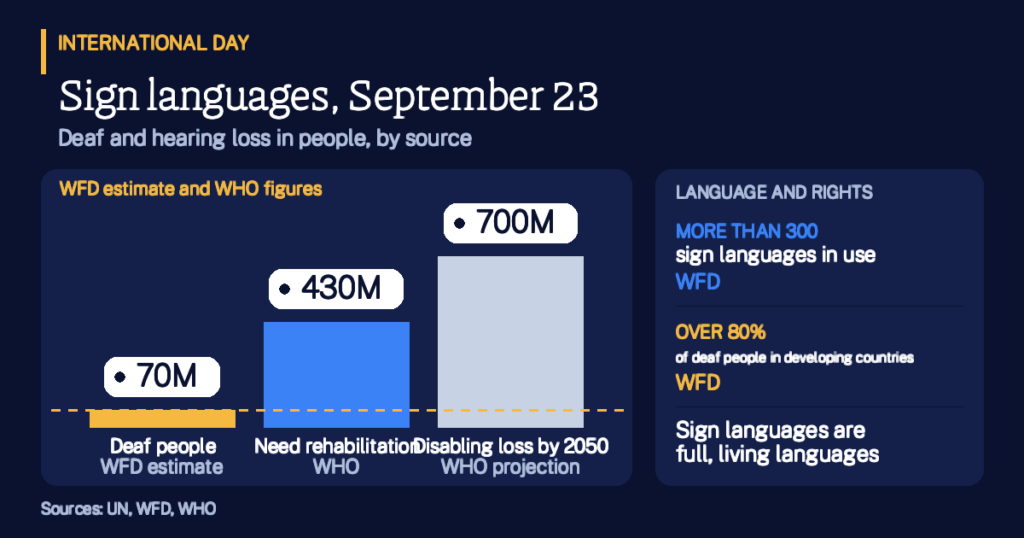
This observance did not start in a government office. The proposal came from the World Federation of the Deaf (WFD), which the United Nations describes as a federation of 135 national associations of deaf people, representing approximately 70 million deaf people’s human rights worldwide. The date honors the WFD’s own history: September 23 commemorates the day the federation was established in 1951.
The General Assembly acted on December 19, 2017. Resolution A/RES/72/161 was sponsored by the Permanent Mission of Antigua and Barbuda, co-sponsored by 97 member states and adopted by consensus, which means no country forced a vote against it. The first observance followed in 2018, as part of the International Week of the Deaf. The day builds on an earlier milestone, the Convention on the Rights of Persons with Disabilities, adopted by the General Assembly in 2006 (A/RES/61/106).
Sign languages are languages
A common mistake is to think there is one universal sign language, or that signing is a gesture code for spoken words. Neither is true. Collectively, deaf people use more than 300 different sign languages, according to the WFD and the UN. Each has its own grammar and vocabulary, and each grows from a community, just as spoken languages do. American Sign Language and British Sign Language, for example, are different languages even though English is spoken in both countries. For international meetings, the WFD has also written about International Sign interpretation, a practical bridge used when signers from many countries gather.
The Convention on the Rights of Persons with Disabilities puts this principle into law. As the UN summarizes it, the Convention recognizes and promotes the use of sign languages, makes clear that they are equal in status to spoken languages, and obligates states parties to facilitate learning sign language and to promote the linguistic identity of the Deaf community.
Example 1: the same meeting, two experiences. Imagine a town hall with 200 residents, ten of whom are deaf signers. With a qualified interpreter, those ten follow every speech and can ask questions. Without one, they sit in silence and learn about decisions afterward. The numbers are round and illustrative, but the gap between participating and merely attending is exactly what the day highlights.
The numbers behind the day
Counting is difficult, because “deaf” and “hearing loss” describe different, overlapping groups. The WFD estimates more than 70 million deaf people worldwide. The World Health Organization (WHO) counts a much larger group: over 5 percent of the world’s population, or 430 million people, require rehabilitation to address disabling hearing loss, including 34 million children. WHO also reports that around 95.1 million children aged 5 to 19 live with hearing loss, and projects that by 2050 over 700 million people, or 1 in every 10, will have disabling hearing loss.
Geography adds a second layer. According to the WFD, more than 80 percent of deaf people live in developing countries, where interpreters, deaf-led schools and captioning are often scarcest. WHO separately reports that nearly 80 percent of people with disabling hearing loss live in low- and middle-income countries. Those two figures measure different groups, but they point the same way.
Why access shapes a whole life
The theme the UN has chosen for the day in recent years centers on rights. The 2024 theme was “Sign up for Sign Language Rights!” It reflects a simple chain: a child who can use a language fully learns, plays and asks questions; an adult who can use it fully can work, vote and seek health care. The UN Secretary-General has said that early introduction and quality inclusive education in sign language are essential for the full and effective participation of deaf people, as guided by the Convention on the Rights of Persons with Disabilities.
WHO lists limitations in access to education and employment among the consequences of unaddressed hearing loss, and it includes training in sign language and sign language interpretation among the services that support rehabilitation. In other words, sign language is not an alternative to care. It is part of care.
Example 2: the clinic visit. Suppose a deaf patient visits a clinic and no interpreter is available. A nurse writes a few notes on paper, but medical terms are hard to convey and the patient leaves unsure how to take a prescription. With a trained interpreter, the same visit takes ten extra minutes and prevents a mistake. These details are illustrative, but the principle matches the UN’s call for accessible services.
Who is still left behind
Progress depends on a few practical things: laws that recognize national sign languages, schools that teach in them, interpreters who are trained and paid, and captioning on public information. The 80 percent figure shows where the gap is widest. Where there are few deaf schools and almost no interpreters, a deaf child may grow up with little exposure to any complete language, and the cost shows up later in learning and work.
Example 3: one interpreter, one district. Imagine a district of 100,000 people with 100 deaf signers and one certified interpreter, who can be in only one place at a time. Add ten more interpreters and the same people can reach schools, courts and clinics in parallel. The numbers are made up for illustration, yet they explain why training and funding matter as much as recognition on paper.
Deaf people are not simply recipients of help. The day comes from deaf leadership, and its message is that deaf communities are linguistic and cultural communities with expertise to share. Related themes appear on other observances, including the International Day of Persons with Disabilities.
How the day is marked
Each year the WFD and national deaf associations organize activities during the International Week of the Deaf, which includes September 23. Governments, schools and broadcasters hold signing events, show captioned or interpreted programs and publish toolkits. The WFD has also promoted a blue light campaign, inviting people to light buildings blue in support of sign languages. A simple personal step is to learn a few signs from your own country’s sign language, ideally from a deaf teacher.
Key Takeaways
- The day belongs to deaf communities. The World Federation of the Deaf proposed it, and September 23 honors its 1951 founding.
- Sign languages are real languages. More than 300 are in use, each with its own grammar and culture.
- The law already says so. The Convention on the Rights of Persons with Disabilities treats sign languages as equal in status to spoken languages.
- The need is large and uneven. More than 80 percent of deaf people live in developing countries, by WFD estimate.
- Hearing loss is growing. WHO projects over 700 million people with disabling hearing loss by 2050.
- Early access changes a life. Education in sign language supports learning, work and health care.
- Anyone can help. Support interpreters, captioning and deaf-led teaching, and learn a few signs.
How solid is this? The count of deaf people comes from the World Federation of the Deaf and is an estimate; WHO’s figures measure hearing loss, a broader group, and its 2050 numbers are projections. The three worked examples use round, made-up numbers to show an idea. See also the International Days hub and the International Days Calendar.
More in Society
- United Nations, International Day of Sign Languages
- UN News, Sign language protects linguistic identity and cultural diversity (September 23, 2019)
- World Health Organization, Deafness and hearing loss fact sheet
- World Federation of the Deaf, UN declared 23 September as International Day of Sign Languages
- UN DESA, Convention on the Rights of Persons with Disabilities, Article 21
- UN General Assembly, A/RES/61/106, Convention on the Rights of Persons with Disabilities