In simple terms Export controls are laws that decide what a country will let leave its territory, and who may receive it. They cover weapons, but most of the argument is about ordinary items with military uses: chips, sensors, software, machine tools, chemicals. How it works The category at the center is dual-use. The European
Export controls Read More »
Export controls are government rules that require a licence before certain goods, software or technology may be sent abroad.
Federalism is a system of government that combines a central, national government with a set of regional sub-unit governments, such as states, provinces, or cantons, each holding genuine governing authority within its own sphere. Unlike a unitary state, where the central government holds ultimate authority and can in principle override or abolish regional governments, a
Federalism Read More »
A system of government combining a central national government with regional sub-unit governments, each holding constitutionally protected authority.
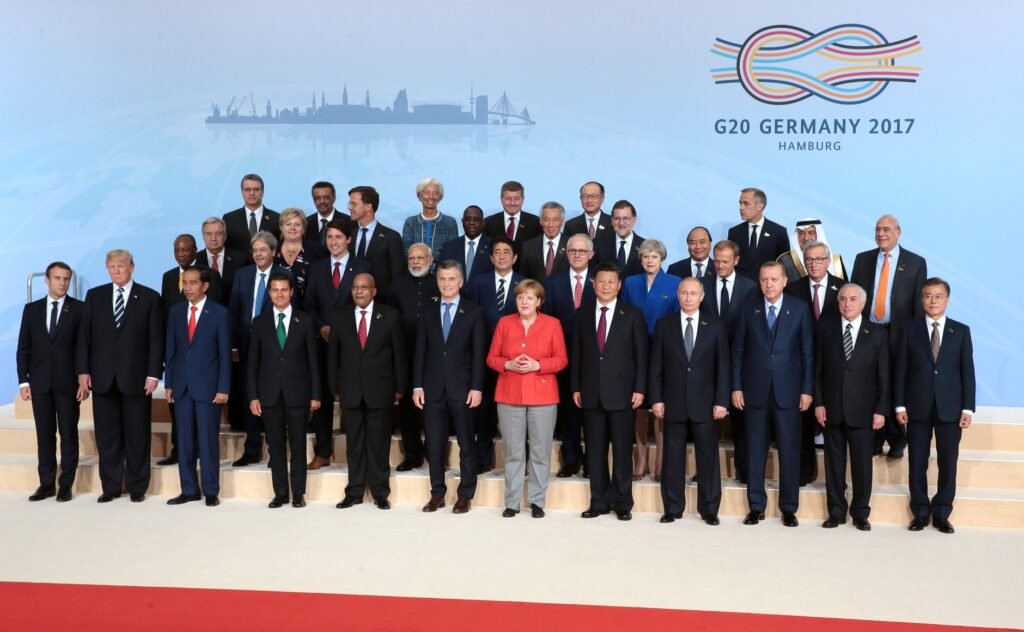
The G20, or Group of Twenty, is an informal forum of 19 countries, the European Union and the African Union that coordinates global economic and financial policy. Finance ministers and central bank governors began meeting in 1999, and leaders held their first summit in November 2008. The G20 has no permanent secretariat, and its presidency
G20 Read More »
The G20 is an informal forum of 19 countries, the EU and the African Union that coordinates global economic and financial policy.
The government of Alabama is organized into three branches under the state constitution: an executive branch led by the governor, a bicameral legislature of 35 senators and 105 representatives, and a judiciary headed by the nine-member Supreme Court of Alabama.[1][2] Executive Governor (four-year term) and 18 other elected offices Legislative Senate (35) and House of
Government of Alabama (Overview) Read More »
The government of Alabama has three branches: an executive branch led by the governor, a bicameral legislature and a judiciary headed by the Supreme Court.
The government of Alaska is the system of state government of Alaska, organized under the Alaska Constitution into executive, legislative and judicial branches. It is headed by an elected governor, a bicameral legislature of 60 members meeting in Juneau, and a unified, state-funded court system. Alongside it operate 19 organized boroughs, 144 cities and 246
Government of Alaska Read More »
The government of Alaska consists of a governor, a 60-member legislature and a unified court system under the 1959 constitution.
The governor of Alabama is the head of the state’s executive branch and is responsible for enforcing state law. The office was created by the Alabama Constitution of 1819, with William Wyatt Bibb as its first holder, and its present form includes a four-year term, the power to sign or veto bills, and appointment authority
Governor of Alabama (Office) Read More »
The governor of Alabama is the head of the state’s executive branch, elected to a four-year term and limited to two consecutive terms.
Healthcare policy is the set of decisions, laws, and plans governments and organizations adopt to pursue specific goals for a population’s health, covering everything from how medical care gets paid for to which medicines reach the market and how diseases are prevented in the first place. The World Health Organization emphasizes that an explicit, well-designed
Healthcare Policy Read More »
The decisions and laws governments adopt to pursue specific goals for a population's health.
Housing policy is the set of government actions aimed at ensuring that housing is available, affordable, and adequate, particularly for low-income and vulnerable households who cannot rely on the private market alone to meet their needs. Governments pursue this goal through a mix of direct provision, financial subsidies, regulation of the housing market, and rules
Housing Policy Read More »
Government action to ensure housing is available, affordable, and adequate, especially for low-income households.
Immigration policy is the set of laws, regulations, and administrative practices a country uses to decide who may enter its territory, how long they may stay, and under what conditions they can eventually become citizens. It sits at the intersection of national sovereignty, labor markets, humanitarian obligation, and domestic politics, which helps explain why it
Immigration Policy Read More »
The laws and practices a country uses to decide who may enter, stay, and become a citizen.
An intelligence agency is a government body tasked with gathering, analyzing, and acting on information in support of a state’s national security, foreign policy, military, and law enforcement goals. Intelligence agencies collect information through methods ranging from entirely open, publicly available sources to highly classified espionage and signals interception, and the information they produce is
Intelligence Agency Read More »
A government body that gathers, analyzes, and acts on information to support national security goals.