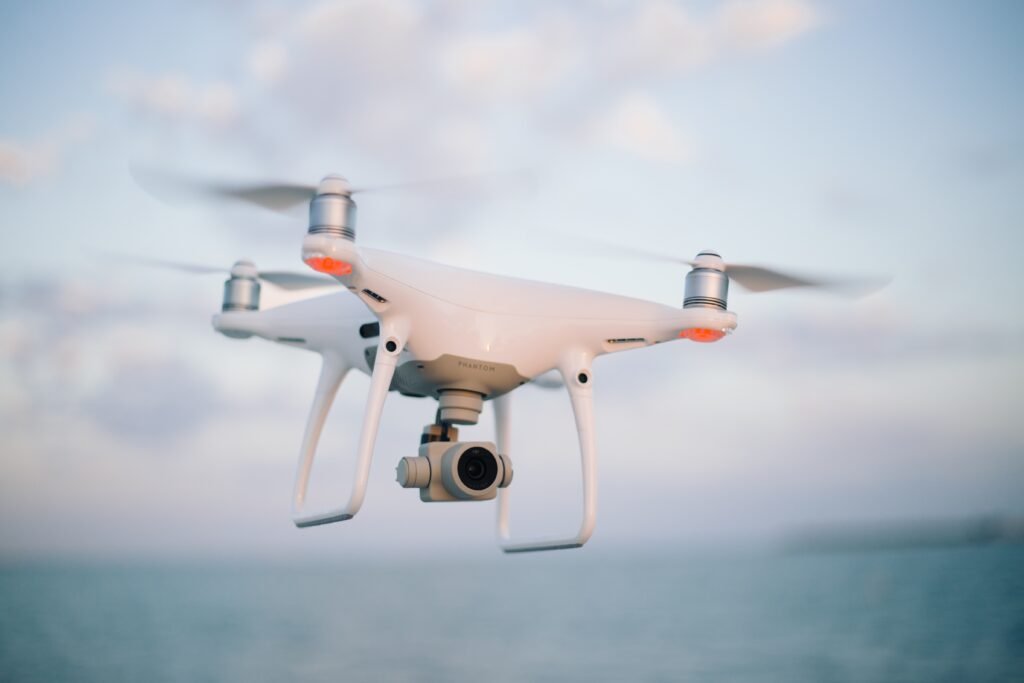
An unmanned aerial vehicle (UAV), commonly called a drone, is an aircraft that operates without the possibility of direct human intervention from on board. It is flown by a remote pilot, by onboard software, or by a combination of the two. The aircraft is usually one part of an unmanned aircraft system (UAS), which also includes the communication links and control equipment needed to operate it safely.
History of unmanned aerial vehicles
Ideas for pilotless flight are older than the airplane. During the American Civil War both armies used balloons to spy on the enemy, and a New York inventor, Charles Perley, received a patent dated February 24, 1863 for a balloon that would release a bomb over a target when a timed fuse burned down. Practical machines followed in the First World War. The Kettering Aerial Torpedo, later called the Kettering Bug, was a small biplane guided by gyroscopes, a barometer and a mechanical computer that counted engine revolutions to gauge distance. It flew in 1918 with a range of up to 75 miles and was never used in combat.
The actor Reginald Denny, who had served in the Royal Flying Corps, formed the Radioplane Company, whose OQ-2 became the first mass-produced UAV. The company built nearly 15,000 aircraft for the U.S. Army and Navy, which used them as targets for antiaircraft training. In the Second World War, Germany launched roughly 20,000 V-1 flying bombs at Allied targets, mainly London and Antwerp, killing more than 10,000 civilians according to the Smithsonian’s account, and the United States attempted to turn modified bombers into radio-controlled weapons in Operation Aphrodite, without reaching intended targets.
After the war, development shifted toward reconnaissance. A drone that began as a target for the U.S. Air Force led to the AQM-34 series, which flew tens of thousands of missions from the mid-1960s to the mid-1970s over North Vietnam, parts of China and even the Soviet Union, avoiding the risk to crews on manned reconnaissance flights. In the 1970s Israel began modifying existing UAVs, and later aircraft such as the Predator were flown by operators thousands of miles from the aircraft.
How UAVs work
Most UAVs combine a few basic parts. The airframe carries the structure and payload. A propulsion system, such as battery-powered electric motors or a fuel engine, provides thrust or lift. A flight controller reads sensors, including gyroscopes and barometers that measure rotation and altitude, as the Kettering Bug did with early mechanical versions, and adjusts the motors or control surfaces many times per second to keep the aircraft stable.
A radio link connects the aircraft to a control station, where the remote pilot sends commands and receives data. Payloads vary with the job and can include cameras, thermal imagers or sensors. Many small drones draw power from lithium-ion batteries, whose limited energy storage is a main reason that flight times are short. Software that interprets images, covered in computer vision, increasingly helps aircraft avoid obstacles and follow routes without constant human input, which links the field to robotics.
Types of UAVs
Fixed-wing UAVs have wings like an airplane and are efficient for long distances because the wings produce lift without spending power to hold the aircraft up. Rotary-wing UAVs, including multirotors with several propellers, can take off vertically and hover, which makes them suited to inspection and photography. Hybrid designs combine vertical takeoff with wing-borne cruising.
Regulators also group UAVs by size. In the United States, Part 107 of the Federal Aviation Administration rules defines a small unmanned aircraft as one weighing less than 55 pounds at takeoff, counting everything on board or attached. Larger military and cargo aircraft fall under different rules and may carry heavier payloads over longer ranges.
Applications of UAVs
The International Civil Aviation Organization (ICAO) lists unmanned aviation uses that include cargo transportation, delivery of life-saving materials, wildlife monitoring, disaster management support and infrastructure inspection. In emergencies, a camera on a drone can survey damage or locate people faster than ground teams, a role related to search and rescue. Conservation groups use them to count animals and watch habitats, as described in wildlife conservation.
Military forces use UAVs for surveillance and reconnaissance, a purpose that dates to the Vietnam War era, and for strikes. Armed use raises legal and ethical debates that are separate from the technology of flight itself.
Rules and regulation of UAVs
Rules differ by country, and the details change, so operators should check their national aviation authority. In the United States, Part 107 of Title 14 of the Code of Federal Regulations sets requirements for small unmanned aircraft. A remote pilot may generally not fly higher than 400 feet above ground level unless the aircraft stays within a 400-foot radius of a structure and no more than 400 feet above that structure’s uppermost limit. Minimum flight visibility from the control station must be at least 3 statute miles, and the rules include a section on visual line of sight operation.
At the global level, ICAO coordinates Standards and Recommended Practices, procedures and guidance for unmanned aviation, with the goal of integrating unmanned aircraft safely, securely and efficiently into the aviation system. Its work covers remotely piloted aircraft systems and unmanned traffic management, which is the idea of tracking and coordinating many low-altitude aircraft, a task related to air traffic control.
Advantages and disadvantages of UAVs
The main advantage is that no one is aboard, so risk to a crew is removed for dangerous or repetitive jobs. Drones can reach places that are hard to access, collect data from above at modest cost, and be launched quickly. The history of the AQM-34 shows how this advantage drove early military adoption.
The disadvantages include limited endurance for small battery-powered models, dependence on a communication link, sensitivity to weather and the risk of collisions with other aircraft, people or property. ICAO notes that the rapid advance of supporting technologies presents challenges for ensuring safe operations. Privacy, noise and security concerns are also part of public debate, and regulations continue to evolve in response.
More in Transport
Key facts
- U.S. rules define a small unmanned aircraft as one weighing less than 55 pounds at takeoff, including everything on board or attached.2
- Part 107 generally limits flight to 400 feet above ground level, with an exception near structures, and requires 3 statute miles of flight visibility.2
- The Kettering Bug flew in 1918 with a range of up to 75 miles but was never used in combat.1
- ICAO lists cargo transport, delivery of life-saving materials, wildlife monitoring, disaster support and infrastructure inspection among unmanned aviation uses.3
Related concepts
In the news
Quick checkHow much can a small drone weigh under U.S. Part 107 rules?Show answer
A small unmanned aircraft weighs less than 55 pounds at takeoff, counting everything on board or attached to it. Rules differ by country.
Sources
- Smithsonian Air & Space Magazine, A Brief History of Unmanned Aircraft, https://www.smithsonianmag.com/air-space-magazine/a-brief-history-of-unmanned-aircraft-174072843/
- Electronic Code of Federal Regulations, 14 CFR Part 107, Small Unmanned Aircraft Systems, https://www.ecfr.gov/current/title-14/chapter-I/subchapter-F/part-107
- International Civil Aviation Organization, Unmanned Aviation and Advanced Air Mobility, https://www.icao.int/safety/UA/Pages/default.aspx
Editorially reviewed by Specialty Digest Editorial TeamLast reviewed November 4, 2026Researched and drafted with AI assistanceReport an issue