Most of us touch cotton before we touch anything else each day: the sheets, the towel, the shirt. We rarely ask who grew it. World Cotton Day, observed every October 7, was created to answer that question. It honors a crop that supports farming families from West Africa to South Asia, shapes trade between rich and poor countries, and asks hard questions about water, labor and fairness. It is also a rare United Nations day that began with a trade request from four of the world’s poorest cotton-growing countries.
From a trade complaint to a United Nations day
The story starts with the Cotton-4: Benin, Burkina Faso, Chad and Mali. In 2003 they launched a cotton initiative at the World Trade Organization (WTO), arguing that subsidies in wealthy countries depressed world prices and hurt farmers who depend on the crop. In 2019 the same four countries proposed a celebration of cotton itself. At their initiative the WTO hosted the launch of World Cotton Day on October 7, 2019, at its headquarters, together with FAO, UNCTAD, the International Trade Centre (ITC) and the International Cotton Advisory Committee (ICAC).
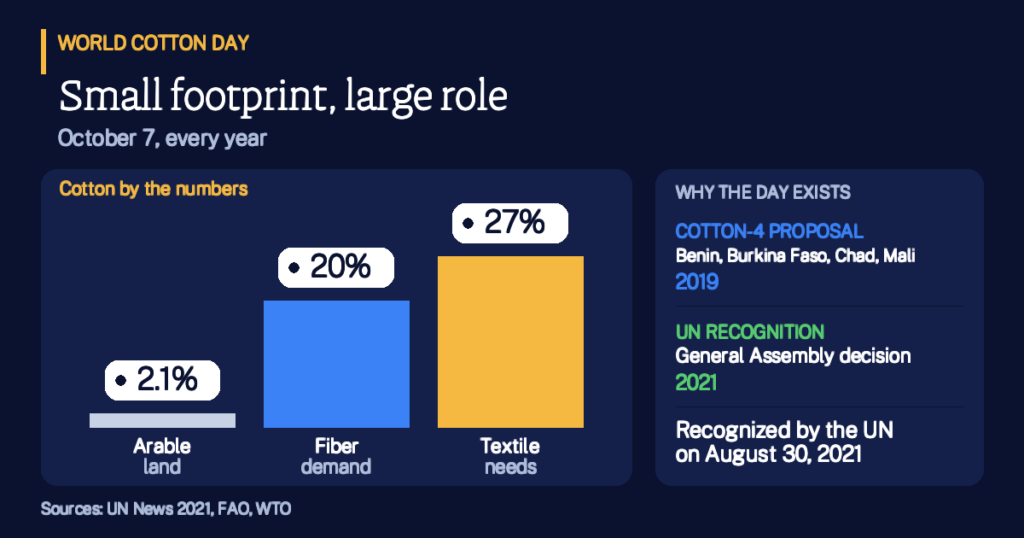
The Cotton-4 then sought formal recognition. On August 30, 2021, the UN General Assembly officially recognized October 7 as World Cotton Day, following a proposal by Benin, Burkina Faso, Chad, Cote d’Ivoire and Mali (resolution A/RES/75/318). The first official UN observance followed that October.
A crop of small farms and long chains
Cotton is grown in roughly 75 to 80 countries across five continents, and the number of people it touches depends on how you count. UN News and the WTO reported in 2021 that cotton benefits around 100 million families. FAO’s current World Cotton Day page counts about 24 million farmers worldwide and an estimated 125 million people employed across the whole value chain, from field to ginning, spinning, weaving and sewing. These are different measures, not a contradiction, and both point to the same fact: this is a crop of small farms and long supply chains. UN agencies add a useful rule of thumb. One tonne of cotton provides year-round work for about five people.
Production is concentrated. FAO reports that China, India, Brazil, the United States and Pakistan together account for more than three quarters of world output. Yet the Cotton-4 and other African producers matter far more to their own economies than their small share of world output suggests, because cotton is often a main source of cash income for rural households.
- 27 milliontonnes of cotton produced worldwide in 2025 (FAO)
- about $46 billionvalue of world cotton production in 2025 (FAO)
- 5 jobsper tonne of cotton, on average (UN, FAO)
- 80%of cotton goes into apparel, 15% into home furnishings (FAO)
Small footprint, large role
Cotton uses just 2.1 percent of the world’s arable land, according to UN News in 2021, yet it meets about 27 percent of the world’s textile needs. FAO gives a different but compatible measure: cotton is the second most used fiber after polyester, with roughly 20 percent of total fiber demand. Its share has been shrinking as synthetic fibers have grown, which is a quiet pressure on the farmers who depend on it.
Example 1: the five-job tonne. Take a cooperative that gins 1,000 tonnes of cotton in a season. At the rule of five jobs per tonne, that is about 5,000 people with work linked to that one harvest, from pickers to truck drivers to weavers. The numbers are round and illustrative, but they show why a price drop reaches far beyond the farm gate.
Trade, subsidies and the price squeeze
About 10 million of the 27 million tonnes produced in 2025 crossed borders, with exports worth nearly $17 billion, FAO estimates. That makes cotton a trade story as much as a farming story. The WTO describes its cotton discussions as focused on reforming trade-distorting subsidies and on better market access for cotton products from least developed countries. FAO notes that many governments support their cotton sectors through direct payments to producers, border protection, crop insurance subsidies and price supports, and that growers face climate change, low productivity and a squeeze between rising costs and flat prices.
Example 2: the squeeze. Imagine a farmer who earns $1,000 from a harvest and spends $700 on seed, fertilizer and labor, keeping $300. If those costs rise 10 percent to $770 while the market price stays flat, the farmer keeps $230, a fall of about 23 percent in take-home income. The figures are made up and round, but they show why a modest rise in costs can hit a small grower hard.
Water, work and the planet
Cotton is often called thirsty, but the picture is mixed. An ILO briefing notes that the crop needs at least 600 millimeters of water a year, from rain or irrigation, and that irrigated cotton supplies about 73 percent of global production, while almost all cotton in Africa and India is rain fed. The ICAC has estimated that about 56 percent of the world’s cotton area depends on rain. That matters for climate resilience, and it links this day to World Water Day, since a crop that relies on rainfall is exposed when rainfall changes.
Labor is the other hard question. The same ILO briefing, dating from 2016, describes child labor in cotton that ranges from underage seasonal harvest work to forced and trafficked labor. It also flags hazardous tasks such as pesticide application and reports that only a minority of cotton-producing states have officially identified cotton picking as hazardous work. It further cites forced labor in places where governments play a key role in the cotton sector. Conditions change over time, so readers should consult the ILO’s current country reports for the latest picture. The aim of the day is not blame but progress: decent work and safe practices across the chain.
Example 3: a basket of shirts. Suppose a shop sells 100 cotton shirts at $20 each, or $2,000 in all. If the farmer’s share were just 5 percent, only $100 would return to the field, while the rest pays for spinning, sewing, shipping and retail. The split is invented for illustration, but it shows why talk of fair prices and better processing near the field, which the 2026 theme calls transformation, matters so much.
How the day is marked
The day is built around events led by the WTO and partner agencies. In 2022 FAO hosted the observance, and in 2025 it took place at FAO headquarters in Rome under the title “Cotton, the Fabric of Our Lives.” On October 7, 2026, the observance was held in Tashkent, Uzbekistan, under the theme “Cotton for Good: Building Prosperity Through Trade, Transformation and Partnership.” Partners listed by FAO include ICAC, ITC, UNCTAD, the WTO, UNIDO and the Joint FAO/IAEA Centre. Ordinary people can take part by checking labels, asking brands about their sourcing, and repairing and reusing cotton goods, which stretches every harvest further.
- 2025Cotton, the Fabric of Our Lives
- 2026Cotton for Good: Building Prosperity Through Trade, Transformation and Partnership
Key Takeaways
- The day began in Africa. Benin, Burkina Faso, Chad and Mali proposed it, and the UN General Assembly recognized October 7 on August 30, 2021.
- Cotton is a crop of families. UN sources cite around 100 million families, and FAO counts about 24 million farmers and 125 million people in the value chain.
- The footprint is small, the role large. Cotton uses 2.1 percent of arable land and meets about 27 percent of textile needs.
- Trade shapes incomes. About 10 million of 27 million tonnes crossed borders in 2025, and subsidies remain a live issue at the WTO.
- Jobs follow the tonne. One tonne supports about five jobs on average, so prices matter well beyond the farm.
- Water and labor need care. Much cotton is rain fed, and the ILO has documented child and forced labor risks that call for decent work.
- You can help. Ask about sourcing, buy fewer and better cotton goods, and keep them in use longer.
How solid is this? Figures come from UN, FAO, WTO and ILO pages, and each carries its year in the text. Counts of farmers and families differ by source and year, so they are shown side by side. FAO’s 2025 production and trade numbers are estimates, and the ILO briefing is from 2016. The three worked examples use round, made-up numbers to show an idea. See also the International Days hub and the International Days Calendar.
More in Society
- UN News. Cotton sustains more than 100 million families worldwide (2021).
- FAO. World Cotton Day.
- FAO. World Cotton Day: Celebrating the role of cotton in global development (2022).
- FAO. Cotton, food and agricultural markets analysis.
- WTO. World Cotton Day 2021.
- WTO. World Cotton Day 2019.
- ILO. Child labour in cotton: a briefing (2016).