Most of the time, peace is invisible. A border stays quiet, a vote takes place without gunfire, a family returns to a village. The people who help hold those moments together often wear a light blue helmet or beret and serve far from home. The International Day of UN Peacekeepers, observed every year on May 29, exists to thank them, to remember those who did not come home, and to ask a practical question: what does it take to keep peace in place? It is closely linked to the work described in the day on multilateralism and diplomacy for peace.
Why May 29
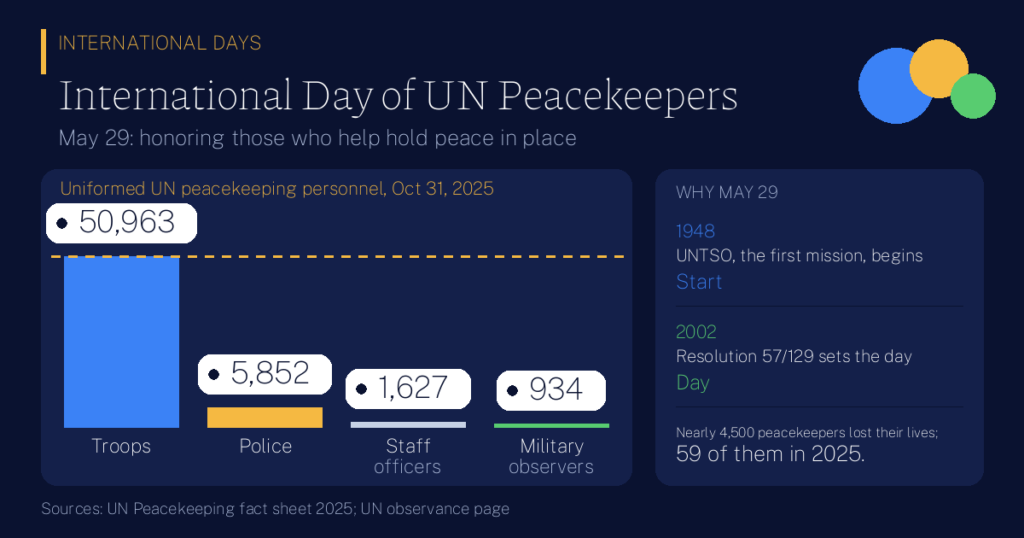
The date points back to 1948. On May 29 of that year, the first United Nations peacekeeping mission, the UN Truce Supervision Organization (UNTSO), began operations in the Middle East, with observers monitoring an armistice. More than 70 years later it is still at work. In December 2002, the General Assembly adopted resolution 57/129, which designated May 29 as the International Day of UN Peacekeepers. The text asks the world to pay tribute to the men and women who have served in peacekeeping operations for their professionalism, dedication and courage, and to honor those who lost their lives in the cause of peace.
What peacekeeping is
Peacekeeping is a way of helping countries move from conflict toward peace. Missions are created by the Security Council and usually operate with the consent of the parties, which sets them apart from a war-fighting force. Their work varies widely. Some missions watch a ceasefire line, as the oldest ones do. Others protect civilians, support elections, help rebuild police and courts, and assist former fighters in returning to civilian life. Peacekeeping brings together soldiers, police officers and civilian experts, and many are volunteers from the country where they serve.
Three ideas guide most missions: consent of the parties, impartiality, and a limited use of force, generally for self-defense and defense of the mandate. Those principles explain why peacekeepers can work among civilians and why they depend on political agreements rather than military victory. A mission cannot create peace by itself. It can protect the space in which people negotiate it.
Example 1: a quiet line. Imagine a ceasefire line patrolled by 100 observers from 20 countries. For years nothing dramatic happens, and that is the point. Each patrol report is a small piece of evidence that both sides can trust, so a misunderstanding is checked before it becomes a clash. The numbers are round and illustrative, but the logic is how observer missions work.
The numbers behind the blue helmets
The UN reports that more than two million people have served as UN peacekeepers across over 70 missions under the UN flag. As of October 31, 2025, the UN Peacekeeping fact sheet counted 11 current operations and 67,783 personnel in total, of whom 59,376 were in uniform: 50,963 troops, 5,852 police, 1,627 staff officers and 934 military observers. Uniformed personnel came from 121 countries, which shows how widely the burden is shared. The UN observance page for 2026 describes a smaller field presence, with more than 51,000 civilian, military and police personnel in 11 missions, so totals shift as missions change and depending on the date and the categories counted.
- Over 2 millionpeople have served as UN peacekeepers
- Over 70missions under the UN flag since 1948
- 121countries contributed uniformed personnel, October 2025
- 11peacekeeping missions in 2025 and 2026
From many missions to a few
The field today is smaller than the history. Over 70 missions have been launched since 1948, and 11 were active in late 2025: UNTSO, UNMOGIP, UNFICYP, UNDOF, UNIFIL, MINURSO, MONUSCO, UNISFA, UNMISS, MINUSCA and UNMIK. Each has its own mandate, region and story. Funding is separate for most of them. The fact sheet states that the approved peacekeeping budget for July 2024 to June 2025 was about $5.6 billion, covering 9 of the 11 missions, while UNTSO and UNMOGIP are funded from the UN regular budget.
Example 2: sharing the load. Suppose a mission needs 1,000 troops and 10 countries each send 100. No single country carries the risk or the cost, and the mission reflects many flags. If one country withdrew, the others could adjust. The figures are round and made up, but spreading the load across many contributors is why the real count of contributing countries matters.
Remembering the fallen
Peacekeeping carries real risk. The UN states that nearly 4,500 peacekeepers have lost their lives in service, including 59 in 2025. The day is as much about remembrance as celebration. Each year, the Dag Hammarskjöld Medal, created by the Secretary-General in December 2000, is awarded posthumously to members of operations who died while serving under UN authority. It is presented to member states that lost military or police peacekeepers, and a medal is also accepted on behalf of civilian staff who died. The UN Headquarters ceremony in 2026 was scheduled for June 5, followed by awards that also recognize living peacekeepers, including the UN Woman Police Officer of the Year and the UN Military Gender Advocate of the Year. The Captain Mbaye Diagne Medal for Exceptional Courage was created by Security Council resolution 2154 on May 8, 2014.
Example 3: a medal for a family. Imagine a country that lost three peacekeepers in a year. At the ceremony, three medals are presented in their names, and the families often hold the medals long after the headlines have gone. The numbers are illustrative, but the purpose is real: to attach names and faces to a statistic.
How the day is marked, and what comes next
The 2026 theme, Invest in Peace, makes an argument many people can follow: prevention and stability cost less than the damage of war. The Secretary-General’s message calls peacekeeping a proven and cost-effective way to restore stability and hope in an era of rising tensions. Observances include a wreath-laying and ceremony at UN Headquarters, events at missions, and tributes in contributing countries. Peacekeepers are often asked to work where a conflict is still unsettled, and they are not a substitute for a political settlement. The day invites people to see them as partners of diplomacy, development and humanitarian effort, not as a stand-alone answer. You can mark the day by reading about a mission in a country you know, thanking a veteran, or asking how your government supports peace efforts.
Key Takeaways
- The date is a birthday. May 29 marks the start of the first mission, UNTSO, in 1948.
- The day has a formal basis. General Assembly resolution 57/129 designated it in December 2002.
- Peacekeeping is shared work. Uniformed personnel came from 121 countries in October 2025.
- Troops are only part of the picture. Police, staff officers, observers and civilians all serve.
- The cost of service is real. Nearly 4,500 peacekeepers have died, including 59 in 2025.
- Remembrance is built in. The Dag Hammarskjöld Medal honors the fallen each year.
- Invest in Peace is the 2026 message. Prevention and stability are the goal.
How solid is this? Personnel figures come from the UN Peacekeeping fact sheet of October 31, 2025, and the fatality, mission and veteran counts from the UN observance page for the day, which describes them in general terms. Totals change as missions open and close. The three worked examples use round, made-up numbers to show an idea. See also the International Days hub and the International Days Calendar.
More in Society